How to Scale Subscription Ecom Brands on Google Ads

By Santosh Kumar, Founder of Shopiator

How to scale subscription ecom brands on Google Ads: why chasing a high ROAS to cover Meta losses caps your growth, how to set a lower target ROAS from 90-day payback, and how to structure the account to capture Meta demand and Google prospecting.
Subscription ecommerce Google Ads accounts usually stall for the same reason. Meta brings in subscribers at a loss on the first order, and the founder asks Google to hit 4x to make up for it. Google does what it is told: it bids on fewer auctions, ROAS looks great, and new subscriber growth flatlines.
A subscription business does not make its money on the first order. It makes it on the rebills that follow. So the question for Google Ads is not "what ROAS can we hit today?" but "how many new subscribers can we buy that pay us back within 90 days?"
This guide covers how to scale subscription ecom brands on Google Ads the way we do it: the payback math that sets a lower, realistic target ROAS, why we keep real order values in the account, and the campaign structure that captures demand from Meta and finds new customers Google can reach on its own.
Why chasing a high ROAS on Google backfires for subscription brands
The pattern is common. Meta prospecting brings in subscribers at a negative first-order ROAS, which is normal for a subscription brand. The blended number looks scary, so the founder sets Google to a high target ROAS to balance the books.
- ▶Google enters fewer auctions. A higher target means it only bids where it expects a big return on the first order, so it shows up less.
- ▶It favours one-time buyers. At full price on day 0 they look better than a subscriber on a discounted first box.
- ▶ROAS looks healthy while growth stalls. You get a good-looking account and fewer new subscribers than your payback range can afford.
Google's own guidance: setting a target that's too high may limit the amount of traffic your ads get, and gradually reducing the target lets the bid strategy enter more auctions and generate more volume. (Google Ads Help, about Target ROAS bidding)
Each channel should be judged on the same thing: what it costs to acquire a new subscriber, against what that subscriber returns in 90 days. Google is not there to make up for Meta.
Set your target ROAS from 90-day payback
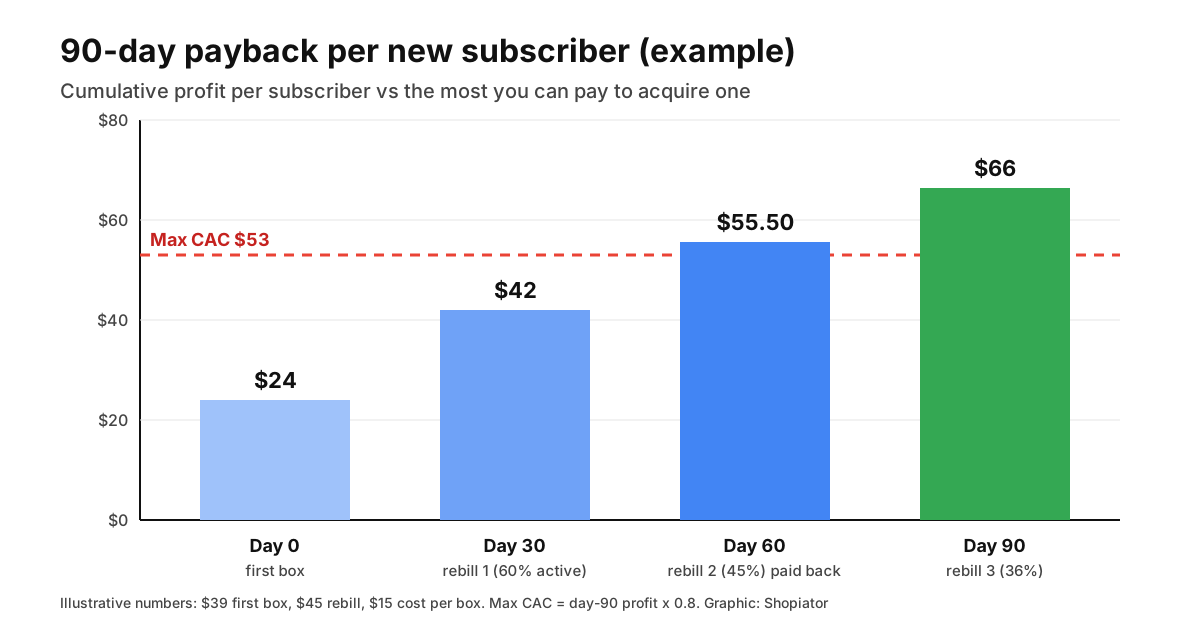
Ninety days is the window most bootstrapped brands can float on card terms and supplier terms. Here is the math on an example supplement subscription. The numbers are illustrative, so swap in your own cohort data.
| Step | Example | How to get yours |
|---|---|---|
| First box price (discounted) | $39 | Your subscription first-order price |
| Rebill price | $45 every 30 days | Your standard subscription price |
| Cost per box (product, shipping, fees) | $15 | COGS plus pick, pack, shipping and payment fees |
| Share still active at rebill 1, 2, 3 | 60%, 45%, 36% | Cohort report from your subscription app |
| Profit by day 90 | $24 + $30 x 1.41 = $66 | First-order profit plus expected rebill profit |
| Max cost per new subscriber | $53 | Profit by day 90, minus a 20% safety haircut |
Example subscription cohort, per new subscriber. Illustrative numbers, not client data.
Now look at what different targets let Google pay for a new subscriber whose first order is $39:
| Target ROAS | Most Google can pay per first order | Inside the $53 payback range? |
|---|---|---|
| 400% | About $10 | Yes, but almost nobody to buy |
| 300% | About $13 | Yes, still leaving most profitable subscribers on the table |
| 150% | About $26 | Yes, with room to spare |
| 100% | About $39 | Yes, close to the sweet spot |
| 70% | About $56 | No, past the payback limit |
In this example the account can afford a target around 100%, a third of the default most brands start with. Start a little higher than your breakeven, then lower it in steps as your cohorts prove the rebills come in.
Set it on the prospecting campaigns, or across them with a portfolio bid strategy so they share one target. Brand campaigns keep their own settings, covered below. Be conservative about the haircut: early cohorts are usually your best, and retention tends to slip as you scale into colder traffic.
Why we don't tell Google what a subscriber is worth
A popular fix is to report the predicted lifetime value as the conversion value, so a $39 first box shows up in Google Ads as $100 or more. We don't do this.
- ▶Smart Bidding bids up to the value you report. Tell it every subscriber is worth $100 and it will happily pay close to that in the auction.
- ▶You hand over your margin. The extra profit from rebills ends up in higher costs per click instead of in more customers.
- ▶Your numbers stop meaning anything. ROAS in the account no longer matches cash in the bank, so every decision after that is guesswork.
Keep the real order value in Google Ads and put your payback math into the target ROAS instead. The target is a number you control and can change any day. Inflated conversion values are a promise to Google about how much you are willing to spend.
Structure the account for Meta demand and Google prospecting
A lower target only works if the account is clean. A subscription brand running Meta has two very different kinds of demand on Google, and they need separate campaigns, separate targets and separate reporting.
| Demand | Campaigns | How to run them |
|---|---|---|
| Created by Meta: people who saw your ads and now search your brand or product | Brand search, branded Shopping (Warm, brand included) | Brand search on Maximize clicks or manual CPC; branded Shopping on a high target ROAS |
| Found by Google alone: shoppers who have never heard of you | Non-brand Search, Shopping and Performance Max (Cold, brand excluded) | Feeder campaigns on Maximize clicks, converters on the lower payback-based target |
| Already subscribed: customers managing their account | None | Customer list for new customer goals, and login, cancel, skip and account as brand negatives |
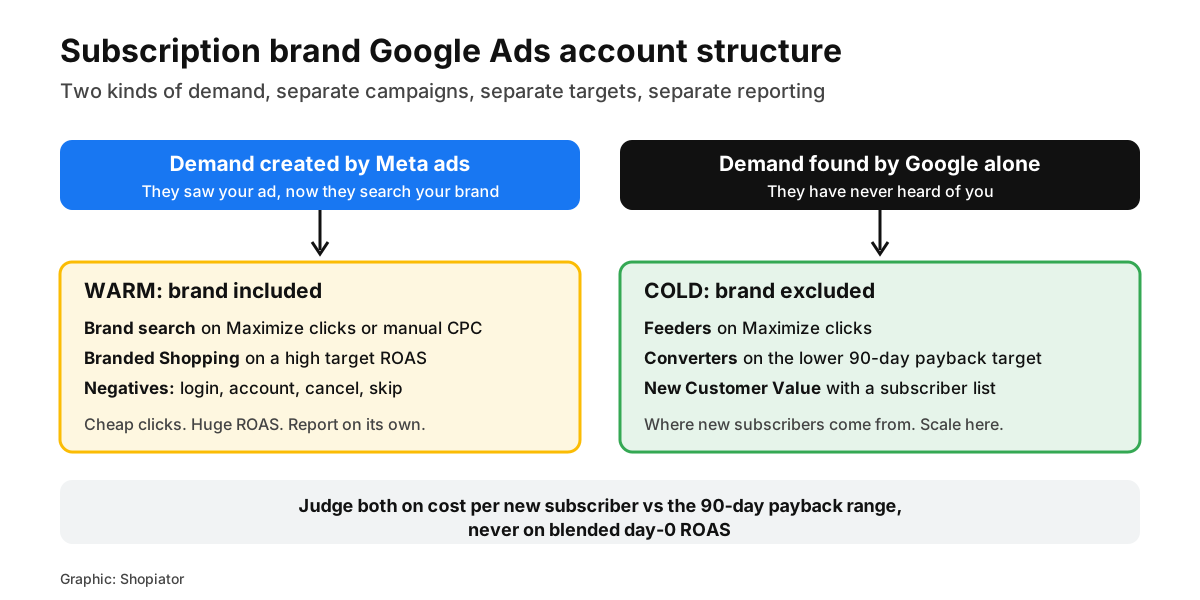
- ▶Exclude your brand from prospecting. Otherwise cheap brand clicks from Meta-created demand flow into the cold campaigns and make prospecting look better than it is. More in our brand bidding strategy guide.
- ▶Judge feeders and converters together. Feeder campaigns bring new shoppers in on clicks and converters close them, so read their combined numbers before cutting either. See our feeder and converter search structure.
- ▶Turn on the new customer acquisition goal in New Customer Value mode. It bids higher for new customers without blocking existing ones. Upload active and past subscribers as a customer list so Google knows who is already paying you.
- ▶Report brand and prospecting separately. Brand search will always show a huge ROAS. Blended into one number, it hides whether Google is actually finding new subscribers.
Subscribe-and-save pricing in Google Shopping
Shopping is where subscription brands most often get a price mismatch. The feed price has to match the price a shopper sees when the landing page loads.
- ▶Page opens on one-time purchase: submit the one-time price. The subscription discount can still go in the description.
- ▶Page opens on subscribe and save: submit the subscription price, and make sure the page makes the recurring charge clear before checkout.
- ▶Never submit the cheaper subscription price while the page defaults to one-time. That is a mismatch Merchant Center can disapprove, and repeated mismatches are a common route into a misrepresentation suspension.
When to scale, hold, fix or cut subscription Google Ads spend
Measure ROAS by conversion time against your payback-based target, and check 7, 14 and 30 days before touching a budget. Google Ads credits a sale to the day of the click by default; by conversion time puts it on the day the order happened, so it lines up with the revenue in your store.
| What you see | What it means | Move |
|---|---|---|
| Target hit on 7, 14 and 30 days, cohorts rebilling on forecast | The model works | Raise budgets up to 20% and recheck |
| Target hit, but impression share lost to budget | You are leaving payback-positive subscribers unbought | Raise the budget before touching the target |
| Target missed on 7, 14 and 30 days | You are paying more than subscribers return | Cut budgets by 20% and check the target and feeds |
| First-rebill rate falling | The offer, product or first box is the problem, not the ads | Fix the offer before adding spend |
| Brand ROAS high, prospecting flat | Google is only catching Meta demand | Move budget into cold prospecting at the payback target |
Smart Bidding needs time after a target change. Move one thing at a time and give it at least a couple of weeks before judging it. To check whether Google is finding new subscribers or just claiming ones Meta already won, see our MER vs ROAS incrementality guide.
How Shopiator scales subscription brands on Google Ads
This is the work we do every day as the world's best Google Ads agency for ecom. We set the target from your payback numbers, not a default, and build the account so Meta demand and Google prospecting each have their own campaigns, targets and reporting.
It is the same structure we have used to scale ecom brands from $0 to $1M a month in revenue from Google Ads within a quarter. See the results on our case studies page.
Tell us your first-order price, rebill rate and Meta spend, and we'll show you the target ROAS your account can afford.
Book A CallFrequently Asked Questions
Can Google Ads really scale without relying on my Meta Ads spend?
Yes, if the account is built to prospect on its own. Google has demand Meta never touches: people searching for your product, the problem it solves or your category who have never seen your ads. Cold campaigns with your brand excluded go after those shoppers. If most of your Google revenue comes from brand search, Google is only catching the demand Meta created, and it will shrink whenever Meta spend drops.
Can Google Ads be structured for cold scaling?
Yes. Cold scaling means campaigns that exclude your brand, so every sale they claim comes from someone who was not already looking for you. We run non-brand Search, Shopping and Performance Max with brand exclusions, feeder campaigns on Maximize clicks bringing in new shoppers, converter campaigns on a target ROAS set from 90-day payback, and the new customer acquisition goal with your subscriber list uploaded. Brand campaigns run separately so they cannot flatter the cold numbers.
How do I judge Google Ads performance for a subscription brand?
Use ROAS by conversion time: conversion value by conversion time divided by cost. Google Ads' default columns credit a sale to the day of the ad click, so a sale today from a click last week inflates last week and leaves today looking weak. By conversion time puts the value on the day the order actually happened, which lines up with your Shopify revenue. Check it over 7, 14 and 30 days, read cold and brand campaigns separately, and compare cost per new subscriber against your 90-day payback range.
Do third-party attribution tools like Triple Whale show better attribution?
They show a different view, not a truer one. Pixel-based tools like Triple Whale credit orders using their own tracking and the attribution model you pick, so the same order can look like a Meta sale in one model and a Google sale in another. They are useful for blended numbers such as MER and new customer counts across channels. They should not decide your Google bidding, because Smart Bidding learns from Google's own conversion data. When the tools disagree, test with a holdout instead of arguing over models; our MER vs ROAS incrementality guide shows how.
Should Google Ads make up for losses on Meta?
No. Meta often acquires subscribers at a first-order loss, and pushing Google to a high ROAS to balance it out just starves Google of volume. Judge both channels on cost per new subscriber against the same 90-day payback range.
What target ROAS should a subscription ecom brand use on Google Ads?
Work it out from your 90-day payback instead of copying a default. Take the most you can pay for a new subscriber and still be paid back within 90 days, and set the target so the cost per new customer stays under that number. For a discounted first box this is usually far below the 300% to 400% most brands default to.
Should I send predicted lifetime value to Google Ads as the conversion value?
We don't. Smart Bidding bids up to the value you report, so telling Google every subscriber is worth three times the first order invites it to spend close to that in the auction. Keep the real order value and put your payback math into the target ROAS, which you control.
When should a subscription brand scale Google Ads spend?
When ROAS by conversion time hits the payback-based target across the last 7, 14 and 30 days and new cohorts are rebilling on forecast. Raise budgets up to 20% at a time. If the first-rebill rate is falling, fix the offer or the product before adding spend.
What price should a subscribe-and-save product show in Google Shopping?
The price a shopper sees by default on the landing page. If the page opens on the one-time option, submit the one-time price. Submitting the subscription price while the page defaults to one-time is a price mismatch, which can lead to disapprovals or a misrepresentation review.
Want the operator to check this on your account?
The Operator Audit is a full manual review of your account: 10 recommendation sets, a live findings call and a prioritized action plan. The $1,299 comes off your first month if you hire us within 30 days.
Keep reading
Ecommerce Purchase Flows: Test Your Store Like a Customer
Ecommerce purchase flows every founder should test on their own store: the 10 steps from ad click to second order, how to run a real test order on your phone, a pass/fail scorecard, and the 7 email flows that fire around them.
ReadGuideHow to Get Google Shopping Rating Reviews
How to get Google Shopping rating reviews in 2026: the 50-review rule, the Product Ratings interest form, Judge.me and XML feed setup, the 2 to 4 week onboarding, policies that get reviews rejected, and fixes when stars don't show.
ReadRankingPrime Circle Agency Review: Pricing, Trustpilot and Alternatives
Prime Circle Agency review for 2026: its BM 8000+ Meta agency ad accounts, six spend tiers from $199 to $1,599 a month plus 3.5% above $40,000, the SHOPIATOR code for 10% off, a 4.4 Trustpilot score from 21 reviews, and how it compares to ExiScale and UpROAS.
Read