Google Merchant Center MisrepresentationWhat It Means, Why It Happens, and What the Issue Messages Tell You

By Santosh Kumar, Founder of Shopiator
Google Merchant Center misrepresentation explained: what the policy covers, why stores get suspended, what each issue and error message means, and what to do next.
Few messages kill a store's Google Shopping revenue faster than the Google Merchant Center misrepresentation issue. Every product disappears from Shopping and Performance Max, and the message from Google explains almost nothing.
This page explains what Google Merchant Center misrepresentation actually is, why stores get flagged, and what the different issue and error messages mean, based on Google's own policy and the suspensions we have worked on.
What Google's Misrepresentation Policy Covers
Google's Misrepresentation policy bans offers that push customers into a purchase without all relevant information, and offers that represent the business or its products inaccurately. Google groups the violations into five areas:
- ▶Unacceptable business practices: hiding or misrepresenting who you are, where you operate, or where products ship from. Suspended without warning.
- ▶Coordinated deceptive practices: concealing your identity on political or social content. Suspended without warning.
- ▶Dishonest pricing and transaction conditions: hidden fees, unclear recurring charges, or shipping and return terms that are not disclosed before purchase. Suspended without warning.
- ▶Unavailable offers: promoting products or deals you cannot fulfil. Warning at least 7 days before suspension.
- ▶Unreliable claims: improbable results such as miracle cures. Warning at least 7 days before suspension.
Why Google Merchant Center Flags Legitimate Stores
Most suspended stores are not scams, which is why the message feels unfair. Google treats every store on the Shopping network like a physical shop. If a reviewer cannot confirm who owns it, where it is, and what its terms are, the store looks like a risk, and the reviewer has no incentive to give it the benefit of the doubt.
- ▶Business name, address, phone, or email on the site differ from the Merchant Center business information.
- ▶The about page does not say which business owns the domain.
- ▶Shipping times or return windows on the site do not match Merchant Center settings.
- ▶A business registered in one country while the store only sells to another, with no explanation.
- ▶Trust signals that do not hold up: inflated review counts, copied content, or social links to empty profiles.
What the Misrepresentation Issue and Error Messages Mean
| Message you see | What it usually means |
|---|---|
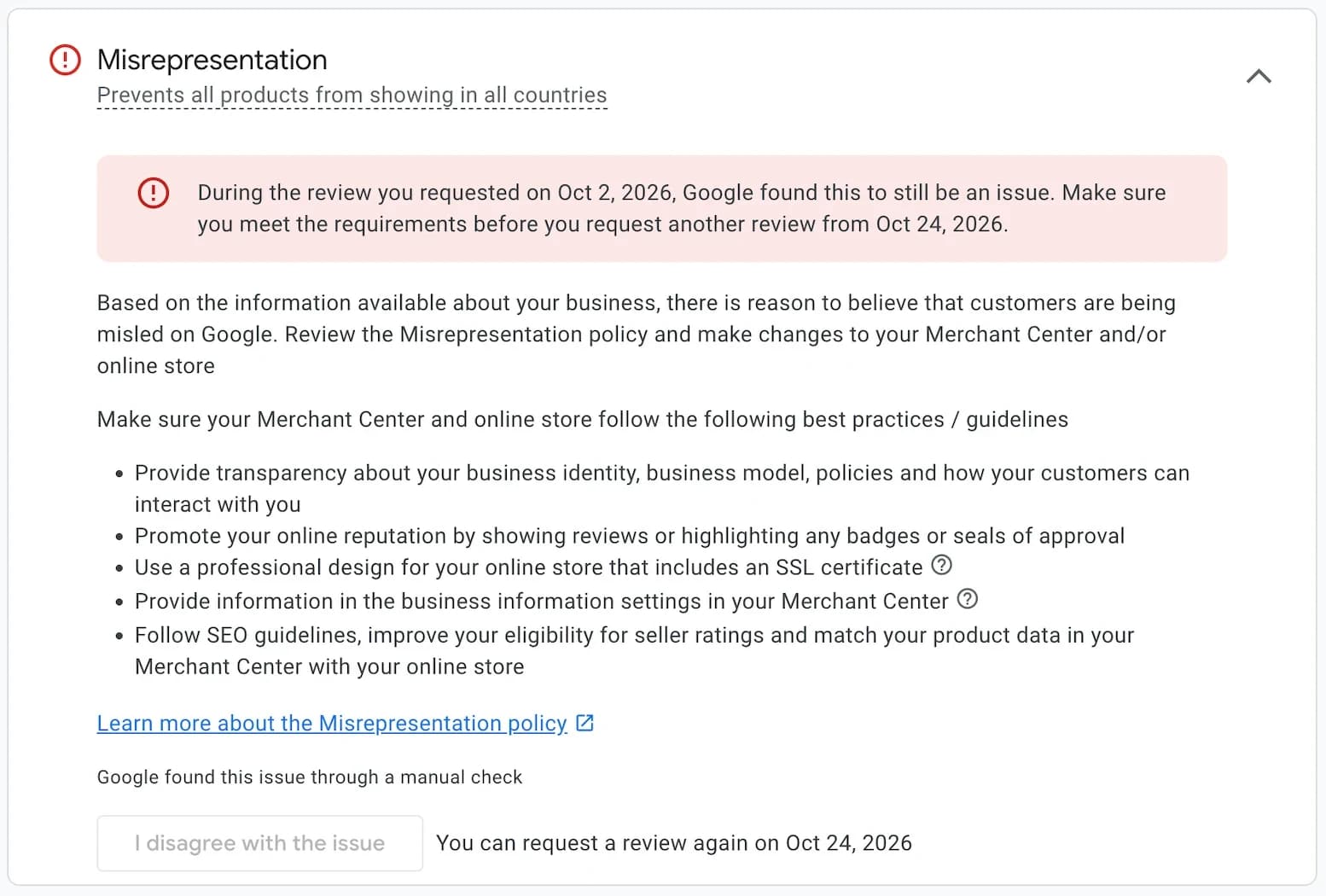
| Misrepresentation: prevents all products from showing in all countries | Account-level suspension. Nothing serves until a review clears it. |
| Google found this issue through a manual check | A human reviewer looked at your site and account. |
| During the review you requested, Google found this to still be an issue | Your last review failed. Fix more before requesting another. |
| You can request a review again on [date] | A cool down period is active. Use it to fix the store. |
| Website needs improvement | Related to misrepresentation: missing or unclear information, broken pages, or placeholder content. |
Shopiator summary of common Merchant Center messages, October 2026.
Why Appeals Keep Failing
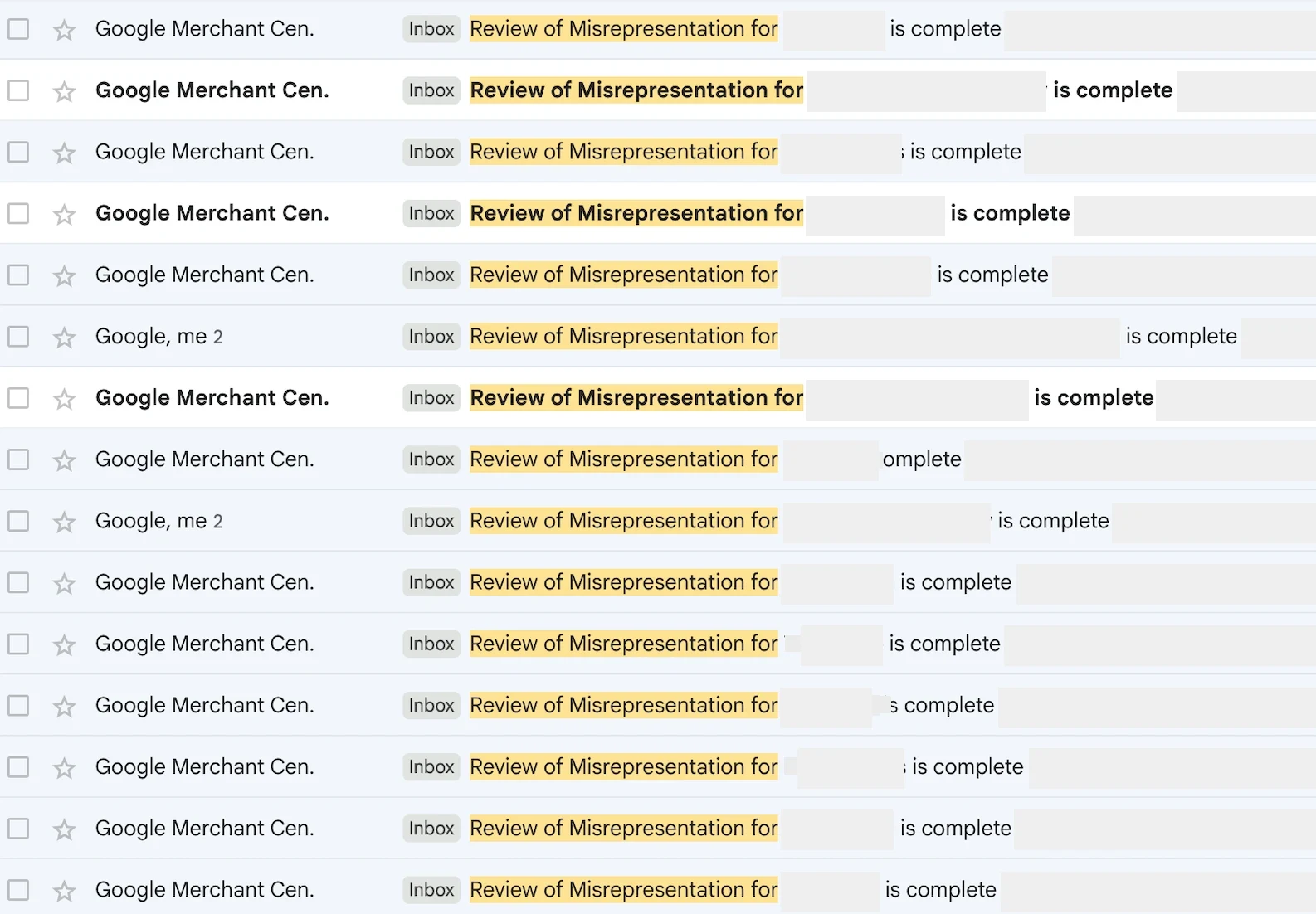
Google's help center confirms that each unsuccessful review can lengthen the cool down before the next one. Stores that appeal first and fix later lose weeks of Shopping revenue per attempt. Changing the site mid-review, appealing before Google has recrawled the changes, or opening a new account to get around the suspension all make the case worse.
How to Fix a Google Merchant Center Misrepresentation Suspension
The fix is a sequence: stop appealing, audit the store against the policy, fix the website first and Merchant Center second, wait for Google to recrawl, complete identity verification, then request one review. Our Google Merchant Center Misrepresentation Fix Guide walks through every step with the 29 checks and the appeal template, and the free checklist preview shows what those checks look like.
If your account is suspended for a reason other than misrepresentation, see Google Merchant Center suspended: every reason and how to get reinstated.
The 29-point fix-then-appeal process and appeal template. $99, instant download.
Get the Google Merchant Center Misrepresentation Fix GuideFrequently Asked Questions
What is Google Merchant Center misrepresentation?
It is a Google Shopping policy violation for listings or stores that Google believes may mislead customers, usually because the business identity, location, policies, or contact details cannot be verified. When it applies at account level, it stops all your products from showing.
What does the misrepresentation issue in Merchant Center mean?
It means Google found, often through a manual check, that your store or Merchant Center account does not give customers enough honest, verifiable information about your business or offers. It does not necessarily mean you did something deliberately wrong.
Does Google warn you before a misrepresentation suspension?
Sometimes. Google says Merchant Center usually sends a warning with a deadline, but for egregious violations the account is suspended immediately without warning.
How long does a Google Merchant Center misrepresentation review take?
Google says review requests typically take 3 to 7 business days. After unsuccessful reviews, a cool down period can apply before you can request another, and it can get longer each time.
Can I appeal a Merchant Center misrepresentation suspension?
Yes, by requesting a review in Merchant Center once you have fixed the issues. Because each failed review can extend the cool down period, fix everything first and appeal once.
Is Google Merchant Center misrepresentation the same as website needs improvement?
They are related. Google treats both as signs your site does not give customers enough clear, trustworthy information, and recommends the same audit: consistent business information, clear policies, a working site with HTTPS, and identity verification.
Suspended right now?
The exact 29-point process behind every misrepresentation suspension we've gotten lifted, with the appeal template we file.
Keep reading
Google Merchant Center Misrepresentation Checklist (Preview)
A free preview of our Google Merchant Center misrepresentation checklist: sample checks to run before you appeal, and where to get the full 29-point checklist.
ReadGoogle Merchant CenterGoogle Merchant Center Suspended: Every Reason and How to Fix It
Google Merchant Center account suspended? The common suspension reasons, warning vs immediate suspension, cool down periods, and how to request a review that works.
ReadRanking14 Best Checkout & Funnel Solutions (2026)
An independent, comprehensive ranking of the best checkout, funnel, and payment routing platforms for ecommerce in 2026. We separate funnel builders, checkout accelerators, payment gateways, and unified platforms so you compare the right category.
Read