Google Ads ROAS Says It's Working. Your MER Says It Isn't.Here's How to Settle It.

By Santosh Kumar, Founder of Shopiator
Google Ads attribution says it's working, your MER says it isn't. Why both can be wrong, and the test that settles it before you fire anyone.
Google Ads ROAS said our account was working. The client's MER dashboard said it wasn't. Neither of us ran the test that would have settled it, and that's the part worth writing about.
The Setup: A Platform ROAS Above 5 and a Client in a Panic
We launched Google Ads for a handbag brand and scaled it fast. Within a few weeks, Google was one of their biggest revenue channels in Shopify's own marketing report, at a platform ROAS above 5.
Then the client started panicking. Their position: we were spending too much on brand, and they'd get those sales organically anyway. The idea came from a viral post by a self-described Google Ads expert. You've probably seen the line. It gets reposted every few months.
The facts:
- ▶Branded search was about 3% of total spend.
- ▶Most of the "brand" revenue they were worried about came from Shopping, where there is no organic equivalent sitting in that ad slot.
- ▶Google's growth was visible in Shopify's reporting, not just inside Google Ads.
None of it landed. They had an internal MER tool that, according to them, showed no incremental sales from Google. They wouldn't share how it worked and wouldn't get on a call.
We ended the engagement. Here's what each side got right and wrong.
What the Client Got Right
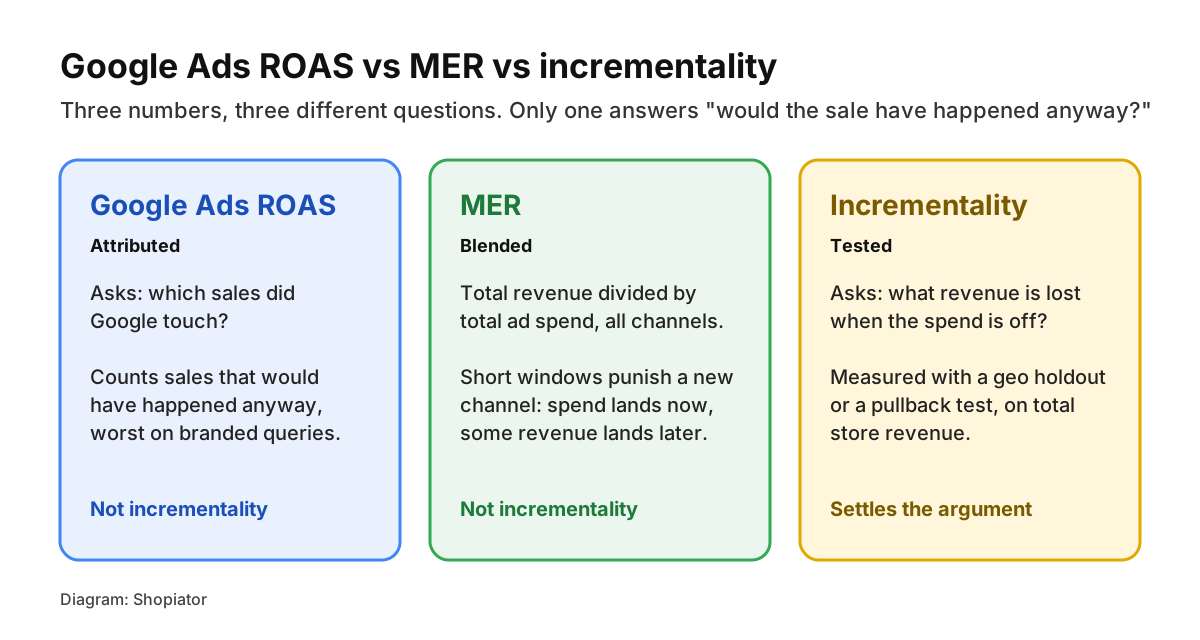
Being suspicious of platform attribution is correct. Google Ads will happily claim credit for a sale that a TikTok video, an email, or a returning customer was going to deliver anyway. Branded queries are the worst offender: a customer who already decided to buy searches your name, clicks your ad, and Google books the conversion.
A founder who looks at blended MER and asks "is this channel actually adding revenue?" is asking the right question. Most don't ask it at all.
What the Client Got Wrong
"We'd get it organically" is a hypothesis, not a finding. It might be true for branded search. In a category like handbags, it's often false: resellers, marketplace sellers and dupe brands bid on brand names constantly. Pull your ads and some of those clicks go to organic, and some go to whoever's still bidding.
3% of spend isn't the problem. If branded search had been 30% of spend, the concern would have been urgent. At 3%, even a worst-case outcome where every branded sale would have happened anyway barely moves account efficiency.
Brand Shopping isn't brand search. Shopping ads on branded queries show product, price and image in a slot that free listings don't reliably win. "Organic will cover it" assumes a replacement that doesn't exist in the same form.
A dashboard you can't inspect isn't evidence. MER tools vary wildly in how they handle attribution windows, new vs returning customers, returns, and conversion lag. A launch account that ramped within weeks will look terrible on a MER tool reading short windows, because spend shows up immediately and some of the revenue doesn't. If nobody can see the methodology, nobody can argue with it, which is exactly why it settles nothing.
What We Got Wrong
The client asked an incrementality question. We answered with attribution reports.
Showing Shopify's marketing report was better than showing Google Ads' own numbers, but it's still attribution. It shows which channel touched the sale, not whether the sale would have happened without the spend. A skeptical founder is right to dismiss it.
What we should have done: agree on how incrementality would be measured before we launched. Not after the panic. At onboarding, when everyone is optimistic and nobody's defending a position.
How to Actually Settle It: Geo Holdout or Pullback Test
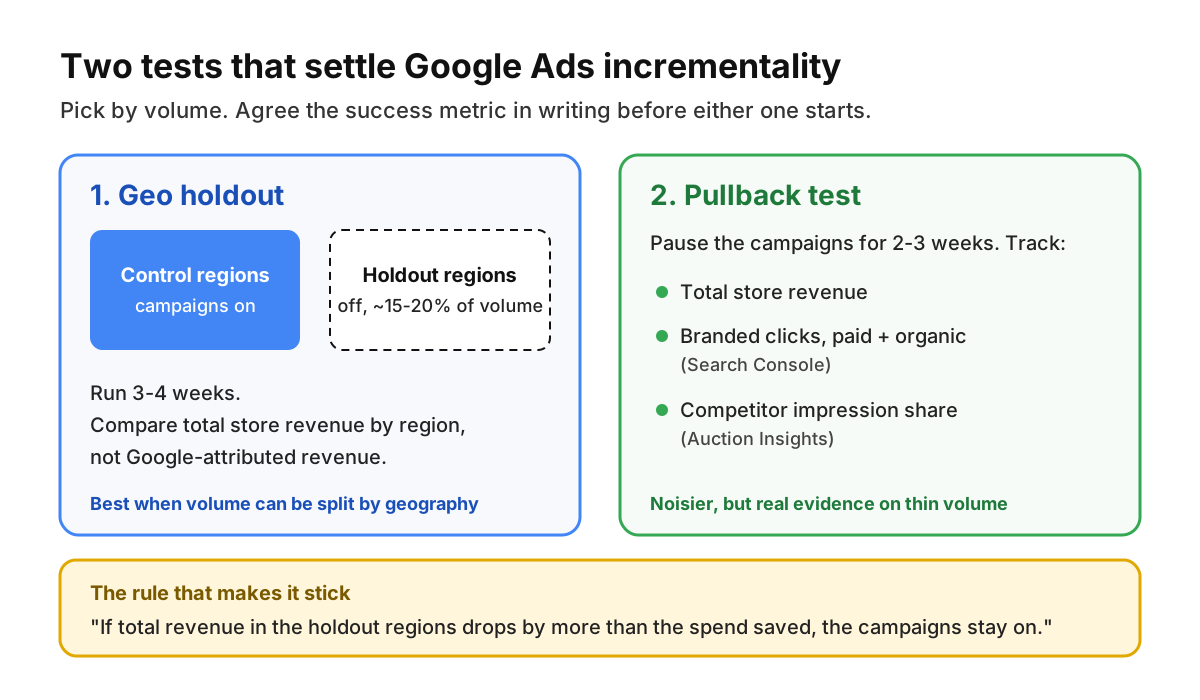
There are two tests that answer "is Google Ads incremental?", a geo holdout and a pullback test, and one rule that makes either of them stick.
1. Geo holdout. Turn off the campaigns in question (brand only, or all of Google) in a matched set of regions covering roughly 15-20% of volume, for 3-4 weeks. Compare total store revenue in those regions against the control regions. Not Google-attributed revenue. Total revenue.
2. Pullback test. If volume is too thin to split by geography, pause the campaigns for 2-3 weeks and track total revenue, branded clicks across paid and organic (Search Console), and competitor impression share in Auction Insights. It's noisier, but it's real evidence.
The rule: agree the success metric before you start. For example: "If total revenue in the holdout regions drops by more than the spend saved, the campaigns stay on." Write it down, get sign-off, then run the test. Without this, whoever dislikes the result will reinterpret it.
The usual result for brand campaigns is not all-or-nothing. Organic recaptures some of the traffic, competitors take the rest, and the right answer is to keep brand running at a tighter target. That's a fine outcome. Both sides get to be partly right.
The Red Flags We Now Screen For
Looking back, the warning signs were there early:
- ▶Strategy beliefs sourced from viral posts, held more firmly than the account data.
- ▶Refusing calls when performance questions come up. A disagreement over email turns into a standoff.
- ▶An internal measurement tool that decides the agency's fate but can't be inspected.
- ▶Judging a launch account on short-window MER, weeks after launch.
Any one of these is manageable. All four together means every bad week becomes a fight over whose numbers are real, and you can't do good work inside that.
Why We Walked
Every account has down periods: seasonality, a feed issue, an auction that gets crowded. With a client who trusts the measurement, a bad week is a problem you solve together. With a client who has already decided the channel isn't working, a bad week is proof.
We'd rather end it cleanly before that happens than spend months defending numbers the client has decided not to believe. Saying "we're not the right fit" early is cheaper for everyone, including the client.
What We Now Put in Writing at Onboarding
What we now put in writing at onboarding
- ▶How incrementality will be measured (geo holdout or pullback test), and roughly when the first test runs.
- ▶The success metric for that test, agreed in advance.
- ▶Which reporting source is the source of truth for weekly performance, and which is the source of truth for incrementality. They're usually different.
- ▶How long the launch phase runs before efficiency is judged.
- ▶A standing monthly call. Performance disagreements don't get resolved over email.
If a prospect won't agree to these, that's the answer.
Frequently Asked Questions
Why do Google Ads ROAS and MER disagree?
Google Ads ROAS is attributed: it counts sales Google touched, including ones that would have happened anyway. MER divides total revenue by total ad spend across every channel. They answer different questions, and neither one measures incrementality on its own.
Is branded search spend wasted?
Not by default. It depends on how many competitors, resellers and marketplaces bid on your brand name, and on how much of your budget it takes. Test it with a geo holdout or pullback test instead of turning it off on instinct.
How long should a Google Ads incrementality test run?
Usually 3-4 weeks for a geo holdout and 2-3 weeks for a pullback test, longer if your conversion lag is long or your volume is low.
What should an agency agree with a client before launch?
The incrementality test method, the success metric, the reporting source of truth, the length of the launch phase, and a regular call. Agreeing these before launch prevents most measurement fights later.
Want the operator to check this on your account?
The Operator Audit is a full manual review of your account: 10 recommendation sets, a live findings call and a prioritized action plan. The $1,299 comes off your first month if you hire us within 30 days.
Keep reading
Google Ads Promotion Mode for Ecom Brands in Q4: A Playbook
A Q4 playbook for ecommerce stores on Google Ads Promotion Mode: how to get it, set it up, time it around Black Friday and keep the sale profitable.
ReadGoogle AdsGoogle Ads Seasonality Adjustments: Should Your Store Use Them?
Should your store use Google Ads seasonality adjustments for Black Friday? What they do, what three years of BFCM data show, and when to skip them.
ReadRankingBest DMCA Takedown Services for Ecommerce Businesses (2026)
The best DMCA takedown services for ecommerce businesses in 2026, ranked: Bustem, DMCA.com, EnforceShield, Red Points, Ceartas and free platform forms, with verified prices and Trustpilot scores.
Read