That's How You Run Google Search Ads in 2026 in the AI Max World

By Santosh Kumar, Founder of Shopiator
How to run Google Search ads in 2026 as an ecom brand, decoded from Google's Ads Decoded episode: consolidation, keywords as themes, AI Max matching and AI Overviews eligibility.
Google put two of its own people on a podcast to explain how Search campaigns should be run in 2026, and the short version is: fewer campaigns, keywords as themes, and more trust in AI Max.
That advice comes from the company that sells the system, so it deserves a decode, not a copy-paste. Below is what was said, what it means for an ecom Search account, and where we keep doing the opposite on purpose.
What this is
Commentary on Google's Ads Decoded episode "Complex queries, simple structure: The new rules of Search campaigns", hosted by Ginny Marvin with Brandon Ervin of Google. Shopiator is not affiliated with Google. We worked from the reporting linked in the Sources section, because we could not read a full transcript. Anything we could not confirm is marked.
What Google Said and What We Do With It
| What Google said | What we do with it |
|---|---|
| Structure should start from conversion goals and budget, not keyword lists. | Agreed. We split by brand, country and role, never by match-type permutations. |
| Merge ad groups that share a goal, budget, creatives and landing page. | Yes for non-brand ad groups with one theme. Not for brand or countries. |
| Keywords are a means to an end and signal the theme of an ad group. | We write one clear theme per ad group and stop enumerating long-tail variants. |
| About 15 conversions in 30 days is the Smart Bidding target. | A campaign below it stays simple and stays on one purchase goal. |
| AI Max can match partial queries from autocomplete. | We read the search term report weekly and check brand leakage. |
| Exact match keywords cannot serve in AI Overviews. | Fine for the feeder. The converter on AI Max carries that surface. |
Consolidation Does Not Mean Merge Everything
According to PPC Land's write-up, the Google guest said structure should start from conversion goals and budget. He gave real reasons to split: distinct budgets and goals, separate regions and seasonal efforts.
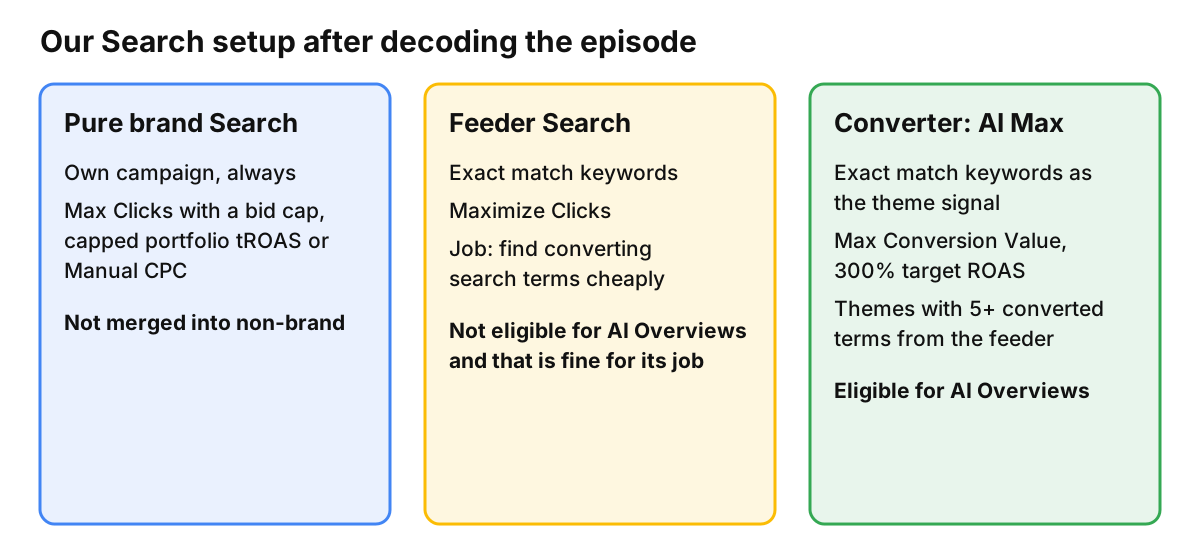
Those exceptions are the whole game for an ecom account. We keep three splits no matter how much Google pushes consolidation:
- ▶Brand and non-brand: brand converts far above average, and mixing it hides what prospecting really does.
- ▶Countries: a US campaign and a CA campaign have different budgets, targets and prices.
- ▶Feeder and converter: one finds terms on Maximize Clicks, the other scales them on a ROAS target.
What we do consolidate: non-brand ad groups with the same goal, creatives and landing page that look identical side by side. If you cannot tell two ad groups apart in five seconds, they are one ad group. The full spend-by-spend map is in our Google Ads scaling structure.
Keywords Are Theme Signals Now
The episode framed keywords as a way to tell Google what an ad group is about, so it can route queries to the right place. With AI Max and broad match, you no longer enumerate every long-tail phrase.
- ▶Write one clear theme per ad group, with a handful of strong keywords.
- ▶Run the side-by-side test: two ad groups should look like distinct concepts.
- ▶Do not pad ad groups with near-duplicate phrases to cover every wording.
- ▶Remember that separate ad groups can undo theming on purpose.
That last point comes from Ginny Marvin in 2024: putting similar keywords in separate ad groups can make both eligible for the auction and essentially remove AI theming. She did not recommend it. It is an option when you truly do not want two similar phrases matched together.
The 15-Conversion Threshold
Google's number for Smart Bidding to work well is roughly 15 conversions in 30 days. The useful detail is that Google can pool learning across campaigns on the same conversion tracking ID, so the data does not have to come from one campaign.
For accounts below it, PPC Land reports Marvin suggested an earlier funnel conversion that still signals intent. Our view: keep purchase value as the goal for any campaign that clears the threshold, and use an earlier event only as a temporary bridge, because switching the bidding goal restarts learning.
What Restarts Learning and What Does Not
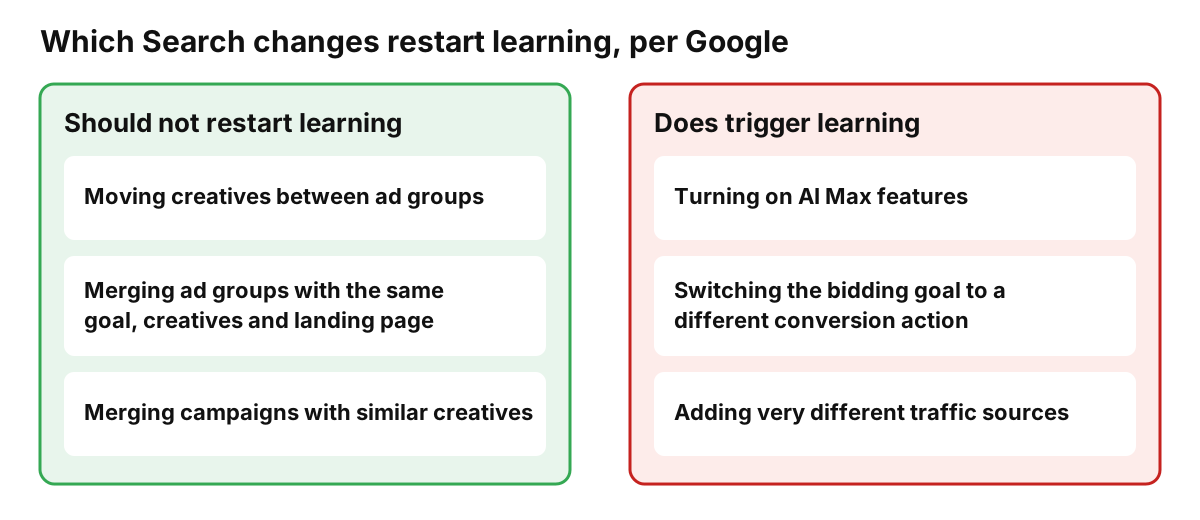
The guest's point was that Google's models weigh semantic features, not campaign or ad group IDs. So moving creatives or merging ad groups with the same goal should not wipe what was learned.
- ▶Should not restart: moving creatives, merging ad groups or campaigns with the same goal and creatives.
- ▶Does restart: turning on AI Max features, changing the bidding goal, adding very different traffic.
- ▶Our rule: change one of the big three at a time, and judge it on ROAS by conversion time.
Why AI Max Matches Half-Typed Queries
The search term report oddities have an explanation. In December 2025, Marvin said one match came from an autocomplete suggestion in Maps search: a user typed "dayca", saw "daycare near me" suggested, and an ad showed.
Standard keyword matching would not connect that partial query to an exact match keyword. AI Max can, because Google is increasingly judging relevance by inferred intent, not just raw text. She also said Google planned to improve transparency on these matches within about a quarter.
- ▶Read the search term report weekly after turning on AI Max.
- ▶Exclude brand from every non-brand campaign, AI Max included.
- ▶Only give AI Max a theme with at least 5 converted terms behind it.
- ▶Expect conversions that exact match keywords would have caught to be credited to AI Max.
AI Overviews Eligibility: Exact Match Is Out
Marvin confirmed in December 2025 that exact match keywords do not serve ads inside AI Overviews, even if the same keyword exists as broad match. Google also said exact no longer blocks broad from showing there, because exact is not competing in that auction.
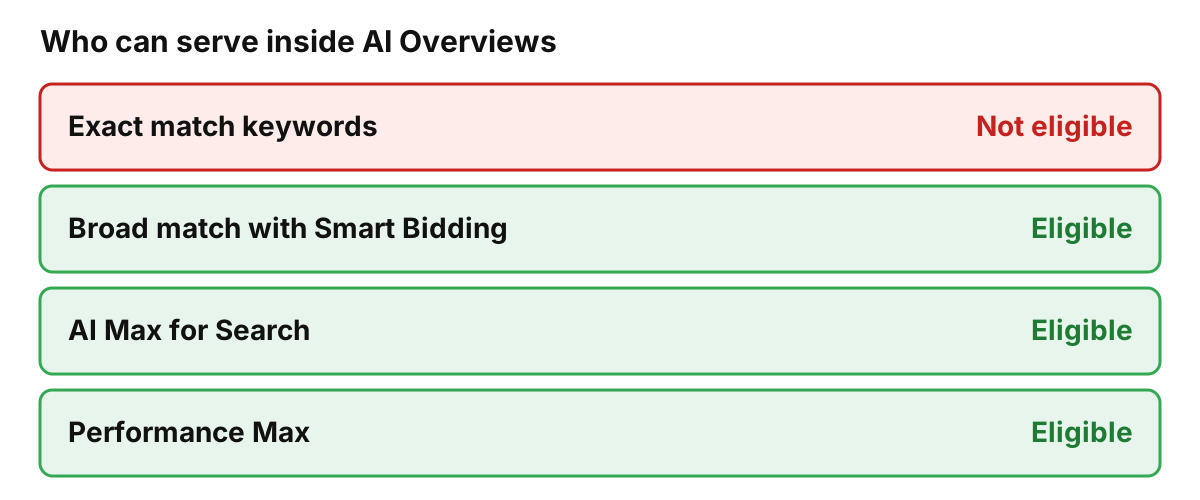
Exact match can still serve above or below the AI Overview. So this is a surface, not a switch. We do not flip the feeder to broad to chase it. The feeder's job is cheap, clean discovery of converting terms. The AI Max converter, which is eligible, carries the AI Overview surface for themes that already proved themselves.
Where We Disagree With the Consolidation Pitch
Fewer, bigger campaigns means more spend flowing through Google's automation, which is the product these guests are paid to explain. That does not make the advice wrong. It means test it, do not convert a working account in one move.
- ▶Consolidate non-brand ad groups that look identical, one change at a time.
- ▶Keep brand, countries and feeder versus converter apart, per Google's own exceptions.
- ▶Judge every change on ROAS by conversion time over 7, 14 and 30 days.
- ▶Never let a keyword spend past $50 without hitting its ROAS goal.
Two Beta Controls Mentioned, Not Verified
A summary of the episode on X also lists two betas: term exclusions that work like negative keywords for assets, and matching restrictions that use natural language to limit ad copy. We could not confirm either in the coverage we found, and your account may not have them, so check before relying on them.
What to Do in Your Account This Week
- 1.List your non-brand Search ad groups and merge pairs that share a goal, creatives and landing page.
- 2.Check each campaign's conversions over the last 30 days against the 15 minimum.
- 3.Confirm brand is excluded from every non-brand campaign, AI Max included.
- 4.Pull the search term report for AI Max and flag partial or odd matches.
- 5.Leave the feeder on exact match and Maximize Clicks.
- 6.Read results on ROAS by conversion time before the next change.
Sources
- ▶PPC Land: why your hyper granular campaigns might be killing performance in 2026, February 15, 2026
- ▶Google: Ads Decoded season 1, episode 2
- ▶PPC News Feed: exact match no longer blocks broad match in AI Overviews, December 2025
- ▶Search Engine Roundtable: Google on AI Max inferred intent versus raw text, December 12, 2025
- ▶Search Engine Roundtable: separate ad group can remove AI theming, August 2, 2024
Frequently Asked Questions
How many conversions does Smart Bidding need?
Google's guidance in the Ads Decoded episode is roughly 15 conversions in 30 days for Smart Bidding to work well. Google can pool learning across campaigns that share the same conversion tracking ID, so the 15 do not all have to come from one campaign. Treat it as a minimum for stable learning, not a target to coast on.
Are exact match keywords eligible for AI Overviews ads?
No. Google's Ads Liaison confirmed in December 2025 that exact match keywords do not serve ads inside AI Overviews. Broad match with Smart Bidding, AI Max for Search and Performance Max can. Exact match can still serve above or below the AI Overview.
Should I merge all my Search campaigns into one?
No. Google's own guest said structure should start from conversion goals and budget, and that separate campaigns are justified for distinct budgets and goals, separate regions and seasonal pushes. Merge ad groups that share a goal, creatives and landing page. Keep brand, countries and feeder versus converter apart.
Does restructuring Search campaigns reset learning?
According to the episode coverage, cosmetic restructuring should not. Moving creatives between ad groups or merging ad groups and campaigns that share the same goal and creatives is not supposed to trigger relearning. Turning on AI Max features, changing the bidding goal to a different conversion action and bringing in very different traffic do.
Why does AI Max match partial queries?
Google's Ads Liaison explained in December 2025 that one match came from an autocomplete suggestion in Maps search, where a partial query turned into a full suggestion that showed an ad. Standard keyword matching would not connect a partial query to an exact match keyword, but AI Max can, because Google is increasingly judging relevance by inferred intent rather than raw query text.
How should an ecom brand use keywords with AI Max?
As theme signals, not as a complete list. Use a keyword to tell Google what the ad group is about, and let AI Max handle long-tail variations. Our converter setup runs AI Max on exact match keywords built from themes the feeder already proved, with a 300% target ROAS, and never on broad match.
Is this post an official summary of the Google episode?
No. It is our commentary. Shopiator is not affiliated with Google. We could not read a full transcript, so each claim below links to the report it comes from. Check Google's own episode page and your account before changing a live campaign.
Want the operator to check this on your account?
The Operator Audit is a full manual review of your account: 10 recommendation sets, a live findings call and a prioritized action plan. The $1,299 comes off your first month if you hire us within 30 days.
Keep reading
Google Ads Scaling Structure for Ecom Brands: High-Level Operator SOP
A high-level Google Ads scaling structure for ecom brands, stage by stage by monthly spend, with the brand split and feeder-converter setup. An operator's SOP.
ReadGuidePreventing Chargebacks: Lessons From Shopify and Netflix
Preventing chargebacks with billing help pages: what ecom brands can learn from Shopify and Netflix, how each explains an unrecognized charge, the seven pages to publish and how to measure them.
ReadGuideEcommerce Purchase Flows: Test Your Store Like a Customer
Ecommerce purchase flows every founder should test on their own store: the 10 steps from ad click to second order, how to run a real test order on your phone, a pass/fail scorecard, and the 7 email flows that fire around them.
Read