Whop Cards - All About ItEligibility, Benefits and More

By Santosh Kumar, Founder of Shopiator
Everything about Whop Cards: how they work, 5% cashback, who is eligible by state and country, team cards, what they decline, and ad spend limits for ecom.
Whop Cards are Visa cards that spend your Whop balance directly, including payments that have not settled yet. They come as physical and virtual cards, for businesses and for individuals, and a business can issue cards to its team with a spending limit on each one. Whop announced the launch in May 2026, per its own newsroom post.
This guide pulls everything from Whop's card documentation into one place, checked October 2026: how the card works, the benefits, the cashback, who is eligible by state and country, what it declines, and the limits that matter if you run ad spend through it.
Shopiator has a referral relationship with Whop, disclosed in full below. We are a Google Ads agency, not a Whop cardholder ourselves, so everything here is sourced from Whop's own documentation and newsroom materials, cross-checked against independent reporting where it exists.
41 of 50
US states where a business entity can be registered and still apply for a Whop Card.
Source: Whop Docs: Supported Regions
How Whop Cards Work
The distinguishing mechanic, per Whop's card documentation, is that the card can spend a balance instantly without waiting for payments to settle. Your pending balance is available to spend the moment a payment comes in, and that applies to card spending, instant payouts, and ad spend.
It does not apply everywhere. A standard withdrawal to your bank pays out settled funds only, and transfers to another account do not draw on pending, so for those the funds have to clear first. Whop's newsroom materials describe the cards as funded through the platform's own stablecoin infrastructure, with transactions processed over Visa, which is also how it offers global access without the currency-conversion friction of a standard cross-border bank transfer.
The card works anywhere that accepts Visa, online and in stores, and you can add it to Apple Pay or Google Wallet in seconds to tap to pay. Whop describes the Visa network as accepted at over 150 million merchant locations worldwide.
Whop Card Benefits
- ▶Speed: spend a balance the moment a payment arrives, without waiting days for funds to clear.
- ▶Cashback: up to 5% back at select participating merchants, earned automatically.
- ▶One place for business funds: Whop's own pitch is keeping all your business funds in one place.
- ▶Mobile wallets: physical and virtual cards both add to Apple Wallet and Google Wallet.
- ▶No extra card fees: Whop's documentation states no extra fees to use the card itself.
- ▶Team cards: issue cards to employees and set custom spending limits per card.
- ▶Treasury: Whop's docs also point to earning up to 6% APY on your Whop balance automatically, covered on its Treasury page.
For platforms, Whop says they can issue cards for their own users via API and earn a portion of interchange at no additional cost to the user. That is a builder feature rather than something a typical seller needs, but it is part of what Whop lists for the card.
Open a Whop account and apply for a business card if your registration is supported.
Get a Whop Card for Your BusinessThe Cashback Rate, and What It Actually Covers
The advertised rate is up to 5% cashback, and it is real, but it is not a flat reward on every purchase. Whop's launch materials named Uber, Whop Content Rewards, and Whop Ads as qualifying, while its current card documentation, checked October 2026, lists Uber with more merchants coming soon. A purchase outside the current list does not earn the 5% rate as of this writing.
This matters because a seller planning to fund day-to-day operating expenses, software subscriptions, inventory, and freelancers on a Whop Card and expecting a blanket 5% back would be pricing in a return the published terms do not offer.
Whop Card vs a Typical Business Debit Card
| Whop Card | Typical Business Debit Card | |
|---|---|---|
| Funding source | Whop balance directly, including pending/unsettled funds | Connected bank account, settled funds only |
| Network | Visa, 150M+ merchant locations | Visa or Mastercard, similar broad acceptance |
| Cashback | Up to 5% on select merchants only (Uber on Whop's current list; Content Rewards and Ads were named at launch) | Varies by bank; often a flat 1-2% or none on a basic business debit card |
| Digital wallet | Apple Wallet and Google Wallet, physical and virtual | Usually supported, varies by issuer |
| Settlement wait | None for in-platform spend; balance is usable immediately | Standard bank settlement timelines apply |
| Team cards | Issued in seconds with a custom limit per card | Varies by bank |
Comparison based on Whop's own card documentation and typical business debit card terms, checked October 2026.
Who Can Get a Whop Card?
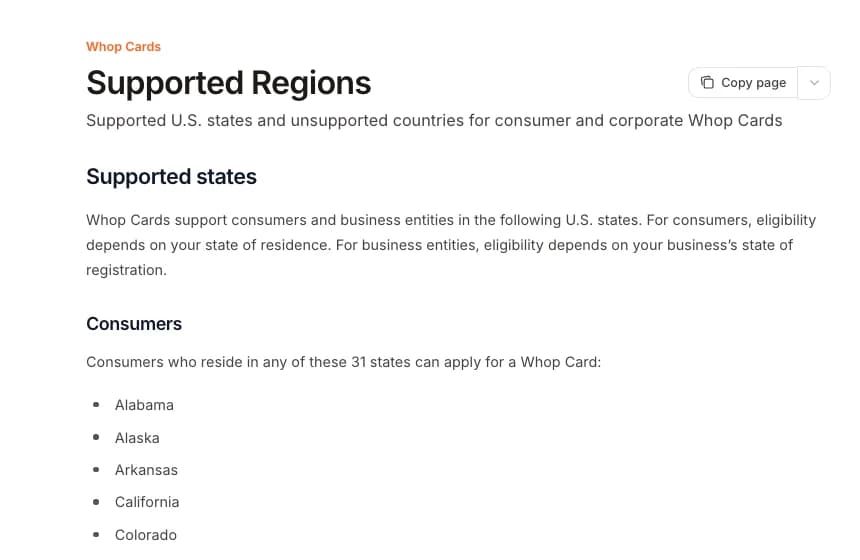
Whop Cards support both consumers and business entities. The rule for each is different, and the business list is the longer one.
| Business card | Consumer card | |
|---|---|---|
| Eligibility follows | State or country of registration | State or country of residence |
| Supported US states | 41 | 31 |
| Unsupported countries | 34 | 18 |
Counts from Whop's Supported Regions page, checked October 2026.
Can onboard
- ▶US businesses registered in one of the 41 supported states.
- ▶Businesses registered in most countries outside the US.
- ▶Businesses that want to spend their revenue and issue team cards.
Can't onboard
- ▶US businesses registered in Idaho, Mississippi, Missouri, Nevada, New Mexico, North Dakota, South Dakota, Tennessee, or Vermont.
- ▶Businesses registered in the 34 listed countries, including China, Hong Kong, India, Israel, Russia, Turkey, Ukraine, and Vietnam.
Which US States Support a Business Whop Card?
Business entities registered in any of these 41 states can apply: Alabama, Alaska, Arizona, Arkansas, California, Colorado, Connecticut, Delaware, Florida, Georgia, Hawaii, Illinois, Indiana, Iowa, Kansas, Kentucky, Louisiana, Maine, Maryland, Massachusetts, Michigan, Minnesota, Montana, Nebraska, New Hampshire, New Jersey, New York, North Carolina, Ohio, Oklahoma, Oregon, Pennsylvania, Rhode Island, South Carolina, Texas, Utah, Virginia, Washington, West Virginia, Wisconsin, and Wyoming.
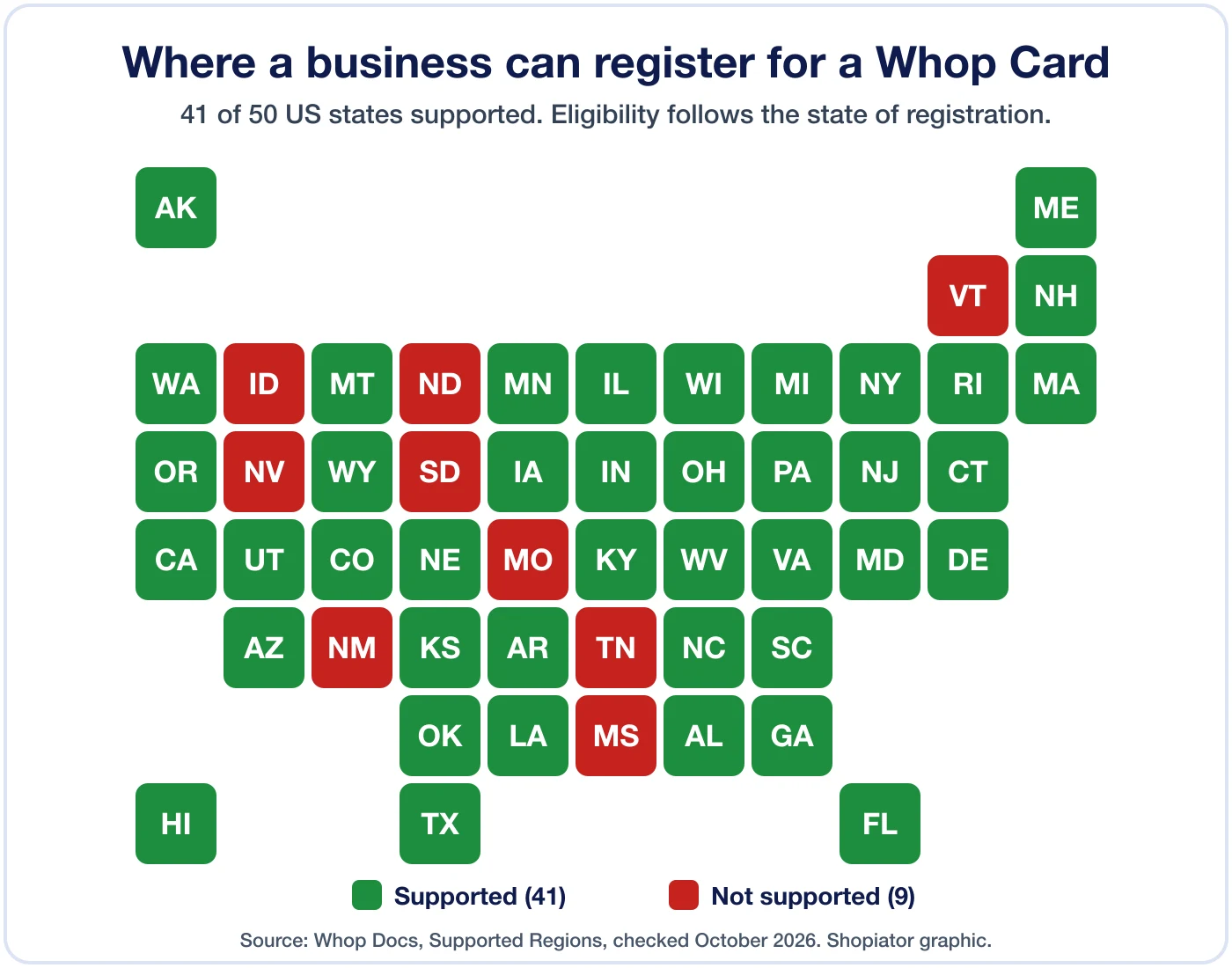
Two states that businesses commonly use for registration, Delaware and Wyoming, are on the supported list. Two others, Nevada and New Mexico, are not.
Which US States Are Not Supported?
Whop does not support business cards for entities registered in these nine states: Idaho, Mississippi, Missouri, Nevada, New Mexico, North Dakota, South Dakota, Tennessee, and Vermont.
Because the rule follows the registration, an owner who lives in a supported state but runs an entity registered in Nevada is still on the unsupported side. Moving an entity is a legal and tax decision, not a card decision, so talk to your accountant before changing where you register just to qualify.
The consumer list is shorter than the business list. Ten states support business cards but not consumer cards: Arizona, Delaware, Georgia, Louisiana, Maryland, Ohio, Oregon, Rhode Island, Washington, and Wisconsin.
Which Countries Can't Get a Whop Card?
Outside the US, Whop issues business cards to entities registered in most countries. It cannot issue them to entities registered in these 34 countries and regions: Algeria, Angola, Belarus, Bulgaria, Burkina Faso, Cameroon, China (Mainland), Croatia, Cuba, Democratic Republic of Congo, Haiti, Hong Kong, India, Iran, Iraq, Israel, Lebanon, Mali, Monaco, Mozambique, Myanmar, Namibia, Nepal, Nicaragua, North Korea, Russia, South Sudan, Syria, Tanzania, Turkey, Ukraine, Venezuela, Vietnam, and Yemen.
Consumer cards exclude 18 countries: Belarus, China (Mainland), Cuba, Hong Kong, India, Iran, Iraq, Israel, Myanmar, Nepal, Nicaragua, North Korea, Russia, Syria, Turkey, Ukraine, Venezuela, and Vietnam. The other 16 on the business list, including Bulgaria, Croatia, and Monaco, are business-only exclusions. Bulgaria and Croatia are the only EU member states on the business list.
Eligibility and spending location are separate. Whop also declines any transaction that originates in a restricted or sanctioned jurisdiction, and says you cannot override those declines.
What Does a Whop Card Decline?
Whop Cards block 60 merchant categories and 116 named merchants by default, and decline them automatically at authorization. Whop states that ATM withdrawals are unavailable by default and that it restricts quasi-cash and certain money-transfer categories.
- ▶Cash and transfers: wire transfers and money orders, manual and automated cash disbursements, quasi-cash, and money-transfer services.
- ▶Securities: securities brokers and dealers.
- ▶Gambling: gambling, betting, and lotteries, plus government lotteries and licensed online casinos.
- ▶Direct marketing: the direct marketing categories, including catalog and telemarketing merchants.
- ▶Named merchants: payment and transfer services such as Wise, Skrill, Neteller, and MoonPay, and brokers such as eToro, among others.
Whop also keeps a dynamic blocklist. It adds merchants that show suspicious activity or high dispute and refund rates, and may remove them after the risk clears, so the list is a moving target. The full lists are on Whop's blocked categories and merchants page.
| Decline reason | What it means | What to do |
|---|---|---|
| Card spending limit exceeded | The charge hit the limit set on that card | Review or raise the card's spending controls |
| Account credit limit exceeded | Not enough available balance for the charge | Add funds to the balance and retry |
| Card locked, canceled, or not activated | The card is not active | Activate or unlock it in the card settings |
| Invalid PIN attempt limit exceeded | Too many wrong PIN attempts locked the card | Unlock the card or contact Whop support |
| Declined by risk rules | The fraud scoring engine declined the charge | Contact Whop support if it looks like an error |
| Restricted country | The charge came from a restricted or sanctioned jurisdiction | It follows compliance policy and cannot be overridden |
Reasons and next steps from Whop's Card Declines and Risk Rules page, checked October 2026.
Will a Whop Card Work for Google and Meta Ad Spend?
This is the question most ecom advertisers care about. Advertising services, merchant category code 7311, does not appear on Whop's blocked category list. But Whop applies default limits to that category that a heavy spender can hit.
- ▶A single advertising services charge above $10,000 is declined.
- ▶More than 40 advertising services charges inside 24 hours are declined.
- ▶More than 20 Google temporary-hold charges on the same card and merchant inside 14 minutes are declined.
- ▶More than 11 card-not-present attempts in 24 hours, or more than two e-commerce attempts inside five minutes, can also trip a rule.
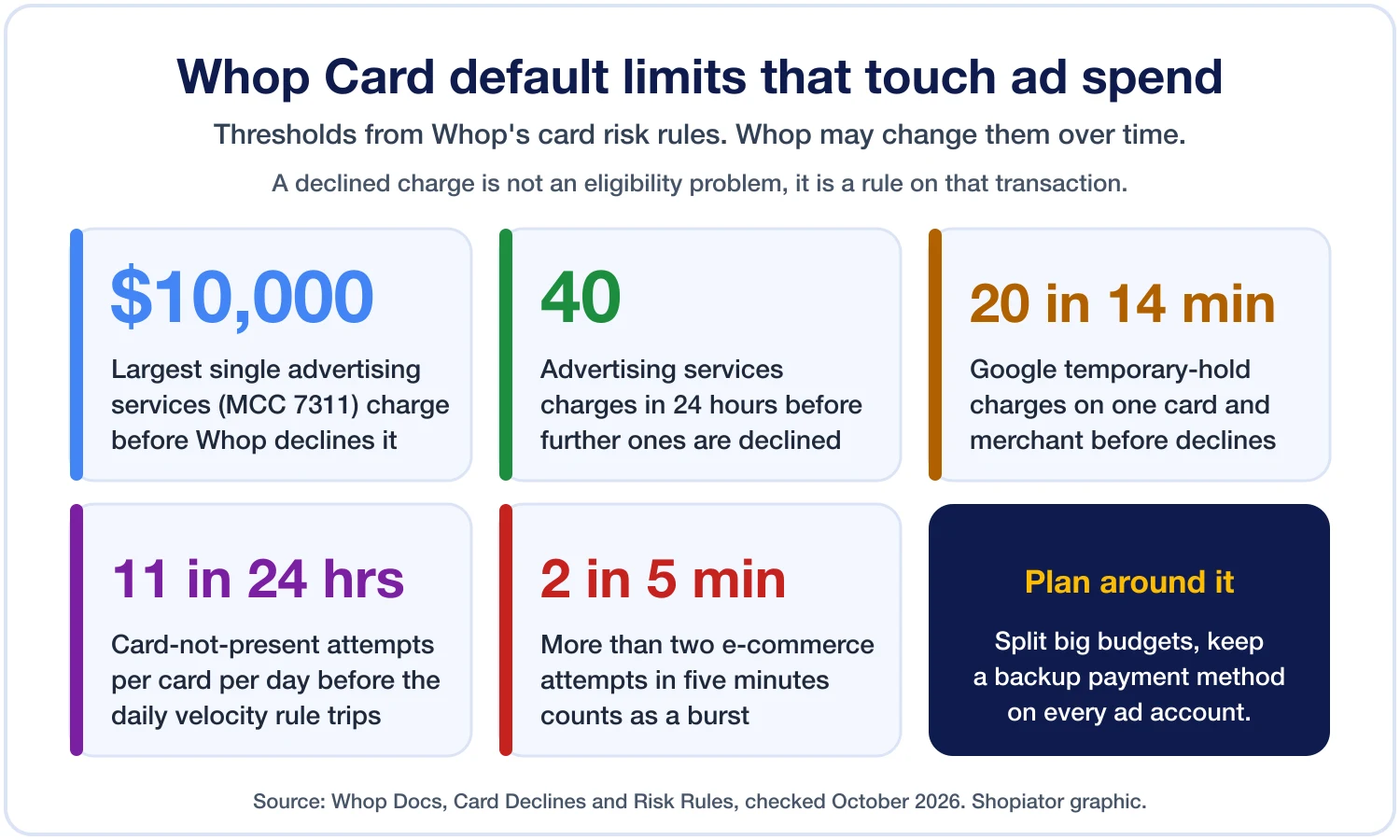
Whop's documentation does not say how any one platform's charges are coded, so check how your ad platform's charges appear on a statement. Platforms that bill in frequent small increments can create many separate charges in a day, which is exactly what the velocity rules count. For big budgets, a second payment method on each ad account is the practical safeguard, because a single declined charge can pause delivery.
How to Check Eligibility Before You Apply
- 1.Find the state or country of registration on your formation documents, not the owner's home address.
- 2.Compare it with the 41 supported states or the 34 unsupported countries above.
- 3.List the vendors you plan to pay and check them against the blocked categories and merchants.
- 4.If you run ads on the card, plan around the $10,000 single-charge and 40-charge daily limits.
- 5.Apply, then set a spending limit on every team card you issue.
Whop's lists can change, so check the supported regions page before you apply and again if your registration changes. If your entity is on the unsupported side, see our ranking of business banks for ecom founders for other ways to get a business card.
Do / Don't
- ▶Do check the current qualifying-merchant list before assuming a purchase earns 5% back.
- ▶Do use the card for the instant-spend benefit even on non-cashback purchases if avoiding a bank withdrawal delay is the goal.
- ▶Do set a spending limit on every team card you issue.
- ▶Do keep a backup payment method on ad accounts that spend heavily.
- ▶Don't plan a budget around a flat 5% return on all business spending; it's scoped to select merchants.
- ▶Don't assume eligibility from where you live; a business card follows where the entity is registered.
Who Benefits Most
- ▶Fits a seller who wants to spend revenue generated on Whop, from a storefront, Content Rewards, or Whop Ads, immediately, without waiting on a bank transfer.
- ▶Fits a business with a team, since cards can be issued to employees with a limit on each.
- ▶Fits a business already spending on Uber regularly, or on Whop Content Rewards or Whop Ads if those still qualify, where the cashback categories overlap with real spend.
- ▶Does not fit a seller expecting a flat cashback rate on general business expenses outside the named merchants.
- ▶Does not fit a business registered in an unsupported state or country, or one that already reconciles all spending through a separate corporate card.
New to Whop or still deciding? Start with why Whop: what it does, what it costs, and who should skip it. For how a balance accumulates and moves before it reaches a Card, see our guide to Whop Wallet, and for the transaction fees that decide how much of a sale lands in that balance, see our Whop payment processing breakdown.
Open a Whop account and apply for a Whop Card once you have confirmed your state or country is supported.
Get Started With WhopFrequently Asked Questions
What is a Whop Card?
A physical or virtual Visa card that spends directly from a Whop balance, including pending funds, instead of requiring a bank withdrawal first. Businesses can also issue cards to team members with a spending limit on each. Whop announced the launch in May 2026, per Whop's newsroom post.
Who can get a Whop Card?
A business can apply if it is registered in one of 41 supported US states or in most countries outside the US. Eligibility follows the state or country of registration, not where the owner lives. Consumer cards follow where the person lives, with 31 supported states. Nine US states and 34 countries are excluded for business cards.
Which states and countries can't get a Whop Card?
For business cards, the unsupported states are Idaho, Mississippi, Missouri, Nevada, New Mexico, North Dakota, South Dakota, Tennessee, and Vermont. Whop also cannot issue business cards to entities registered in 34 countries and regions, including China, Hong Kong, India, Israel, Russia, Turkey, Ukraine, and Vietnam. Delaware and Wyoming are both on the supported list.
How much cashback does a Whop Card actually earn, and on what?
Up to 5%, but only on select merchants, not all purchases. Whop's card documentation, checked October 2026, lists Uber as the participating merchant with more coming soon. Whop's launch materials had also named Whop Content Rewards and Whop Ads, so check the current list before counting on them. Purchases outside the named merchants do not earn the advertised rate.
How does spending a pending balance work?
Whop says your pending balance is available to spend on the card the moment a payment comes in. That applies to card spending, instant payouts, and ad spend. A standard withdrawal to your bank pays out settled funds only, and transfers to another account do not draw on pending, so those funds have to clear first.
Is the Whop Card accepted everywhere, and does it work with Apple Wallet or Google Wallet?
It runs on the Visa network, which Whop describes as accepted at over 150 million merchant locations worldwide, online and in stores. Physical and virtual cards can be added to Apple Wallet or Google Wallet for contactless payment, per Whop's card documentation.
What does a Whop Card decline, and can I use it for ad spend?
Whop blocks 60 merchant categories and 116 named merchants by default, including wire transfers, cash disbursements, securities brokers, and gambling, and ATM withdrawals are unavailable by default. Advertising services is not blocked, but Whop declines a single advertising charge above $10,000 and more than 40 advertising charges in 24 hours. These are default thresholds that Whop may change.
Can employees get their own Whop Cards, and are there fees?
Yes. Whop says a business can issue cards to team members in seconds and set a custom spending limit on each. Whop's documentation states no extra fees to use the card itself. The cost consideration is how funds reached the balance, since Whop's standard processing and payout fees still apply there.
Disclosure: Shopiator has a referral relationship with Whop and may earn a commission if you sign up through the links on this page, at no extra cost to you. Shopiator does not operate, resell, or control Whop's card program and is not responsible for approvals, declines, limits, cashback terms, or Whop's decisions on your account.
Keep reading
Whop Wallet: How Whop's Payout Ecosystem Works
Every sale on Whop lands in a seller's Whop balance first, the layer that connects a storefront to Whop Cards, bank withdrawals, and every other Whop financial product. Here's how funds actually move, what payout timing and holds look like, and how it compares to a typical Stripe payout cycle.
ReadCreator CommerceWhop CLI: Running Your Business From the Terminal
Whop CLI gives business owners, and their AI agents, direct terminal access to Whop's full API: launching products, setting prices, managing ad campaigns, and moving money without a developer. Here's what it actually lets you do, and who it's genuinely built for.
ReadGuideIndependent Google Ads Audits for Ecommerce: A Second Opinion
If your Google Ads dashboard looks fine but revenue isn't moving, the numbers are probably real and still misleading. Here's why blended ROAS hides the truth, why we don't run the free-audit-as-sales-pitch playbook, and five real US providers, ours included, offering an independent second opinion for $49 to $1,299 without requiring you to switch agencies.
Read