Scaling an Ecommerce Business

By Santosh Kumar, Founder of Shopiator
Scaling an ecommerce business from $100K to $100M a year, with a stage-by-stage plan for paid ads: what to run, what to measure, when to hire an agency, and the mistakes that stall growth.
Scaling an ecommerce business is mostly a sequence problem. Most of what works at $5M a year is useless at $100K, and a lot of what worked at $1M becomes a bottleneck by $30M. The mistake is skipping ahead, adding agencies, channels and campaign layers before the earlier layer is stable.
Sean Frank laid out his own revenue ladder on X on October 13, 2026, from $100K to $100M. It is mostly about the business: team, product and infrastructure. This guide takes the same ladder and answers a narrower question that his thread leaves open: what should your paid ads be doing at each stage? The stage thresholds are his. The ad recommendations are ours, and we mark them as our own.
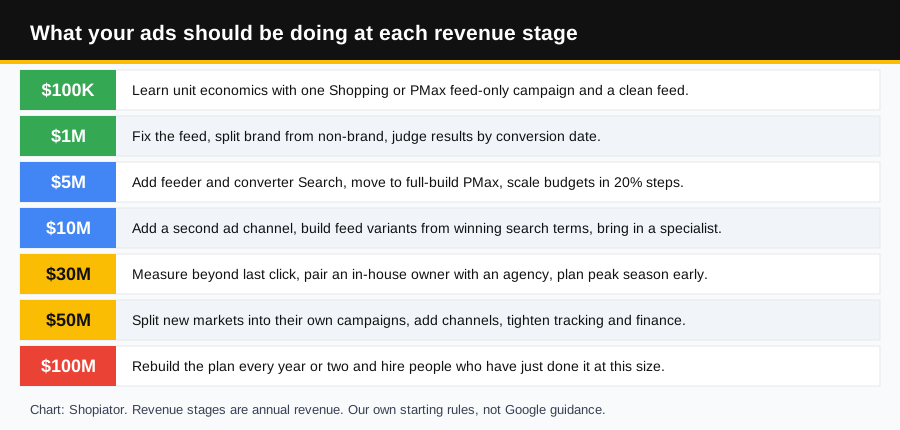
What does scaling an ecommerce business actually look like by revenue?
Frank's ladder, in short: almost any product can reach $100K and $1M with a little skill. Around $5M you need one sales channel and one marketing channel where you are in the top 10%, and a product category big enough to hold that revenue. At $10M you need to be good at two things, and agencies start to give you their best work. From $30M you cannot hold the business together alone. At $50M you need real banking, a real accounting setup and a growth plan that is not one product on one channel. At $100M, he says, the playbook changes every couple of years, so advice from someone who has not just done it is out of date.
We agree with the shape and none of it is controversial. Where we add something is on the ad side, because that is where we see brands stall. The rest of this post goes stage by stage.
What should ads do at $100K a year?
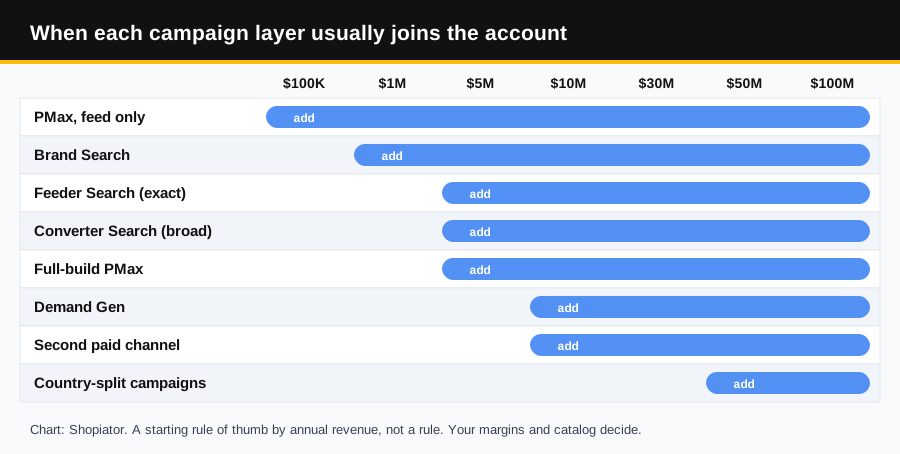
Learn your unit economics, nothing more. You are testing whether a product sells at a price that leaves room for ad cost, and the cheapest way to find out on Google is Shopping or Performance Max running off your product feed.
- ▶Fix the product feed before you spend: titles that match how people search, accurate prices and stock, real images. Our Google Shopping feeder and converter guide covers the structure.
- ▶Run one feed-only Performance Max or Shopping campaign. Do not build full creative yet.
- ▶Work out your break-even ROAS: 1 divided by your contribution margin after product, shipping and fees. Anything above it earns, anything below it loses.
- ▶Skip agencies. At this size the work is small, and the learning is worth more than the time saved.
What changes at $1M a year?
You now have enough conversion data for Smart Bidding to work with, and enough brand search that it distorts your numbers. Two jobs matter.
- 1.Split brand from non-brand. Brand traffic converts cheaply and flatters blended ROAS. Put it in its own campaigns so you can see what prospecting really earns. Our setup in most accounts: brand Search on Maximize Clicks or manual bids with a low cost-per-click cap, never on target ROAS, and brand Shopping on a high ROAS target. See PMax cannibalizing brand traffic for why this matters.
- 2.Judge results by conversion date. A click on Monday that buys on Friday belongs to Monday's spend. Reading by click date makes new campaigns look worse and old ones better than they are. Check the 7-day, 14-day and 30-day views before you change a bid or a budget.
For targets, our starting point in most setups is 3x ROAS for a feed-only Performance Max campaign. Treat that as a default to override with your own margin. Our Performance Max architecture guide explains feed-only versus full build.
How do ads change at $5M a year?
This is the stage Frank calls the point where you have to know what you are doing: one sales channel and one marketing channel where you are clearly good. For Google, that means building a structure instead of a pile of campaigns.
- ▶Feeder and converter Search. A feeder campaign on exact match with Maximize Clicks finds the searches that convert. A converter campaign on broad match with a ROAS target scales them. Never run a feeder on a ROAS target. See feeder versus converter campaigns.
- ▶Full-build Performance Max. Add asset groups with real creative on top of the feed-only campaign. Our usual starting target is 3.5x in most setups.
- ▶Budget moves in steps of about 20%. Raise a budget by up to 20% only when the 7-day, 14-day and 30-day trends all hit target, and cut by 20% when they do not. Bigger jumps reset learning and hide the cause.
- ▶Watch spend per product and per keyword. Do not let a single product or keyword spend more than it can earn back while missing target.
What changes at $10M a year?
Frank's point at this level is that you need to be good at more than one thing, and that you can finally afford good agencies. In ads, that usually means three changes.
- ▶A second paid channel, only after the first holds its ROAS target on its own.
- ▶Feed variants built from search terms that already convert, so each winning term has a product listing written for it.
- ▶A specialist agency or hire. Read how to choose a Google Ads agency for ecom and the agency pricing guide before you sign, and the in-house hiring math if you are weighing a hire.
What changes at $30M, $50M and $100M?
These are mostly business changes, and ads follow them.
| Stage | What changes in the business | What changes in the ads |
|---|---|---|
| $30M | The founder cannot hold everything. A team and mentors are needed. | An in-house owner paired with an agency, measurement beyond last click, and early planning for peak season. See our Black Friday playbook and Promotion Mode guide. |
| $50M | Real banking, real accounting, and growth beyond one product on one channel. | New markets as their own campaigns (we keep US and Canada separate), new channels, and tighter tracking. |
| $100M | Every growth lever has to work at once, and the plan changes every couple of years. | Rebuild the structure regularly, and hire people who have recently done it at this size. |
Stage thresholds and business changes from Sean Frank's October 2026 post on X. Ad changes are Shopiator's view.
Who should run your ads at each stage?
Frank argues that good agencies give a $5M brand less than their best, and that it only changes around $10M. We would put it more carefully, because the answer depends on what you need rather than on revenue alone.
- ▶Under $1M: you, or a single freelancer. The feed and the unit economics matter more than who clicks the buttons.
- ▶$1M to $10M: a fixed-scope audit, setup or short engagement often beats an open-ended retainer. You want someone who can build the structure and hand you a clear way to run it.
- ▶$10M and up: a specialist agency with an internal owner on your side who understands the numbers, so you can tell good work from busy work.
What stalls ecommerce growth, and what is the fix?
- ▶Raising budgets faster than the account can hold its target. Move in steps of about 20% and wait for the 7, 14 and 30-day views.
- ▶Reading results by click date. Use conversion date, or you will cut campaigns that are about to pay back.
- ▶Blended ROAS hiding weak prospecting. Keep brand separate.
- ▶One product on one channel. Frank's own warning at $50M. Add products, channels or markets before the first one saturates.
- ▶The founder as the bottleneck. Frank says a strong CEO cannot hold a $30M business together alone. Build the team before you need it.
For real account data on where these numbers land, see our Google Ads benchmarks for ecommerce brands. If your account is already past $5M and the structure feels stuck, join the Shopiator waitlist and we will tell you honestly whether we are the right fit.
Sources
Revenue stages and business advice: Sean Frank, post on X, October 13, 2026. Ad recommendations, starting targets and campaign structure: Shopiator's own working rules from running Google Ads for ecommerce brands. They are starting points, not Google guidance, and your margins decide the real numbers.
Frequently Asked Questions
How do you scale an ecommerce business with paid ads?
Add one layer at a time as revenue grows. Start with a clean product feed and one Shopping or Performance Max campaign, split brand from non-brand around $1M, add feeder and converter Search and full-build Performance Max around $5M, then add channels and markets once the first channel is stable. Judge every step by ROAS on conversion date, and change budgets in steps of about 20%.
How much revenue do you need before hiring a Google Ads agency?
There is no fixed number. Sean Frank argues that good agencies give small brands their second-best effort and become affordable and attentive around $10M a year. Our read: below that, a clean feed and a single owner of the account matter more than a retainer. Between $1M and $10M, a fixed-scope audit or setup often makes more sense than an open-ended agency contract.
What should ad spend be as a share of revenue?
We do not publish a single percentage, because it depends on gross margin, repeat purchase rate and how much revenue comes from other channels. The useful number is your break-even ROAS: 1 divided by your contribution margin. Set your ROAS target above it and let spend rise only while the target holds.
When should you add Performance Max to an ecommerce account?
Early, as a feed-only campaign, because it runs on your product feed and needs the least creative. Move to a full-build Performance Max campaign with asset groups once the feed is clean and you have creative worth testing. Our starting tROAS is 3x for feed-only and 3.5x for full build in most setups, which your margin should override.
Why separate brand and non-brand campaigns?
Brand traffic converts cheaply and makes blended ROAS look better than your prospecting really is. Splitting them shows what non-brand spend actually earns, and lets brand Search and brand Shopping run on different bidding from the rest of the account.
What stalls growth most often at $5M to $30M?
Per Frank, the founder becoming the bottleneck, and needing one sales channel and one marketing channel where the brand is clearly strong. On the ad side, we most often see budget raised faster than the account can hold its ROAS target, and results judged by click date instead of conversion date.
Want the operator to check this on your account?
The Operator Audit is a full manual review of your account: 10 recommendation sets, a live findings call and a prioritized action plan. The $1,299 comes off your first month if you hire us within 30 days.
Keep reading
Google Ads Channel Prioritization: What Ecom Brands Should Set
Google Ads channel prioritization and budget allocation explained for ecom brands: High vs Low priority by bid strategy, Shopping and PMax options, and the February 2027 Display change on Search.
ReadGuideShopify Payments Holding Your Money? A Q4 Cash Flow Plan
Why Shopify Payments holds payouts or applies a reserve, what Shopify says to do, and how to test a backup processor like Whop before Q4 peak.
ReadCreator CommerceTop Whop Clipping Offers of Oct 2026 - How To Earn Money with Whop Content Rewards
Top Whop clipping offers of October 2026: live Content Rewards campaigns ranked by open budget, with pay per 1,000 views, payout limits and how to earn.
Read