Best Cities for Online Entrepreneurs in 2026Choose Your Company's Home and Yours Separately

By Santosh Kumar, Founder of Shopiator

Seven cities ranked for online business owners who can work from anywhere: company setup, tax clarity, banking, internet and community, plus the entity-versus-home-city pairings that matter most.
Most lists of the best cities for online entrepreneurs treat the question as one decision: where should I live. For an online business it is two. There is the city and country where your company is registered, banked and taxed, and there is the city where you actually sit. Getting those two right independently is worth more than any single city on a ranking.
This ranking scores seven cities for online business owners who can work from anywhere. It is different from our ranking for ecommerce entrepreneurs, which weighs sourcing and fulfillment, and from our nomad and expat rankings, which focus on visas and long-term residency.
The Two-Address Rule: Where Your Company Lives vs. Where You Do
Your company's country decides your payment processor, bank, corporate tax rate and the compliance you answer to. Your own city decides your visa, your personal tax residency, your costs and your time zone. They only have to match if you choose to make them match.
The trap is assuming that a foreign company makes you tax-free wherever you live. Personal tax residency generally follows physical presence, with many countries using a 180 or 183 day test, so a low-tax company run from a high-tax home can still leave you exposed. Treat that as a conversation to have with a cross-border adviser before you move, not after.
€415
Approximate cost to start an Estonian company through e-Residency in 2026: a €150 card plus a €265 state registration fee.
How We Scored These Cities
Each city gets 1 to 5 on five factors, for a total out of 25. These are editorial judgments built from public data, not a survey.
- ▶Entity setup: how quickly and cheaply a non-resident can form and run a company there.
- ▶Tax clarity: how predictable the company and personal tax picture is for a location-independent founder.
- ▶Banking access: whether a business account and a mainstream payment processor are realistic.
- ▶Internet and time zone: connectivity and working-hour overlap with US and European customers.
- ▶Community: how many other online founders you can meet, hire and lean on.
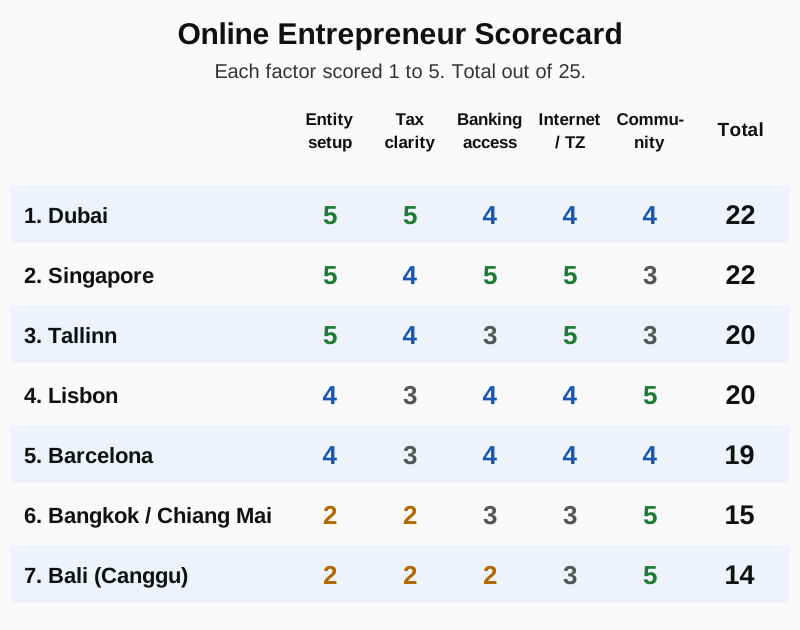
1. Dubai: Company, Tax and Home in One Place
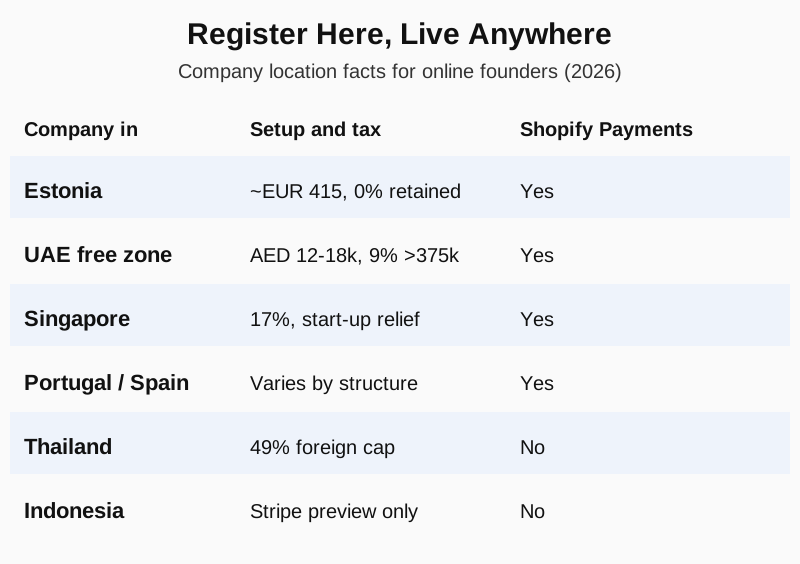
Dubai scores 22 of 25 because it is one of the few places where the company and the founder can live in the same city without friction. The UAE charges 9% corporate tax above AED 375,000 and 0% below it, with a possible 0% rate for qualifying free zone income, and Dubai does not levy personal income tax. Shopify Payments and Stripe both support UAE-registered companies.
Licence prices vary widely by source, so compare first-year totals. One 2026 comparison puts IFZA near AED 12,000 to 18,000 and DMCC higher, with real first-year costs often 1.5x to 2x the headline. Confirm the 0% treatment applies to your specific income before you rely on it.
2. Singapore: The Best Banking and Infrastructure
Singapore also scores 22. It leads on banking access and infrastructure, and the 17% corporate rate is softened by start-up exemptions of 75% on the first SGD 100,000 of taxable income for three years and 50% on the next SGD 100,000. The weak point for an online founder is the cost of actually living there, which is why many register in Singapore and live elsewhere in the region.
3. Tallinn: The Cheapest Serious EU Company
Tallinn scores 20. Estonia's e-Residency lets a non-resident form and run an Estonian company (an OÜ) entirely online, and the company pays 0% corporate income tax on profits that stay in the business. The application fee is €150, rising to a flat €165 from January 1, 2027, and Estonia is on Shopify's supported-countries list.
e-Residency is not residency
It is not a visa, residence permit or tax residency, and it does not change where you personally pay tax. That depends mostly on where you physically spend your time, commonly 183 days or more in 12 months. Banking for e-residents can also be slower than the setup, so plan for it.
4. Lisbon: The Best Community Plus Euro Access
Lisbon scores 20 and has the strongest online-founder community in Europe. Portugal is supported by Stripe and Shopify Payments. The D8 digital nomad visa reportedly needs average income of four times the minimum wage, €3,680 a month in 2026, measured over three months. Portuguese tax treatment for new residents has changed repeatedly, so get current advice before basing a move on it.
5. Barcelona: A Strong EU Base With a Tax Trade-Off
Barcelona scores 19. Spain's digital nomad visa reportedly requires about 200% of the national minimum wage in monthly income, no more than 20% of it from Spanish sources, and visa holders may be eligible for the 24% Beckham Law flat rate. That can be attractive for high earners and punishing for others, so model your actual numbers.
6. Bangkok and Chiang Mai: Cheap Living, Awkward Company Setup
Thailand scores 15. Living costs and infrastructure are excellent, but foreign ownership of most Thai companies is generally capped at 49% unless you use a route such as BOI promotion, and Shopify Payments is unavailable for Thai companies. Thailand has also taxed remitted foreign income since January 1, 2024 for tax residents, who are anyone present 180 days or more in a calendar year.
The common pattern is a UAE, Singapore, Estonian, UK or US company, with Thailand as the place to live. Our ecommerce ranking covers the payment constraints in more detail.
7. Bali: The Biggest Online-Founder Scene, the Weakest Company Base
Bali scores 14. Canggu and Ubud host one of the largest communities of bootstrapped online founders in the world, but Stripe is only in preview for Indonesia and the reported E33G remote worker visa needs about $60,000 in annual income. Treat Bali as a home base and keep the company elsewhere.
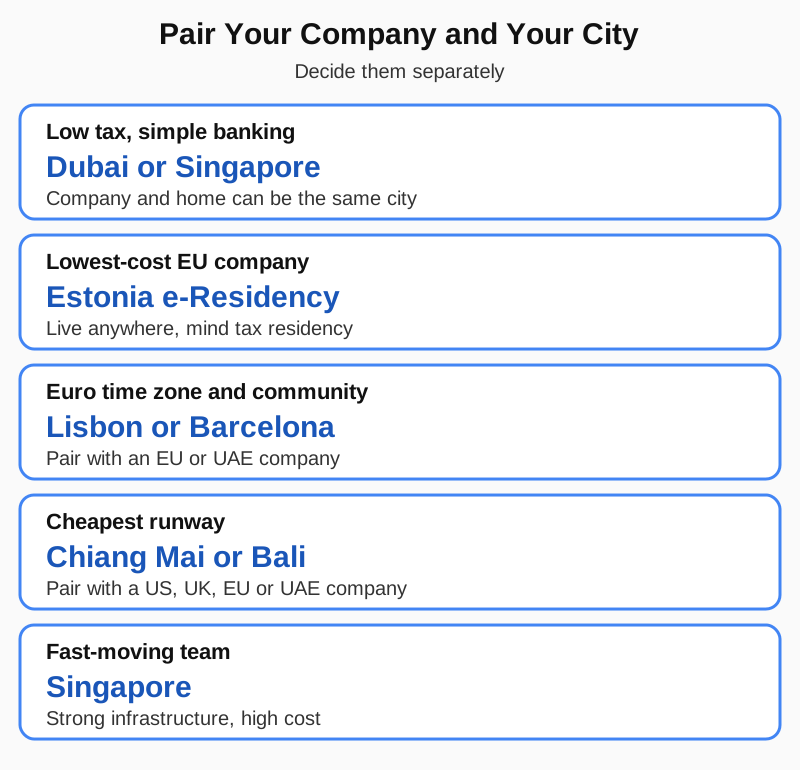
Best City Pairings for an Online Business
The strongest setups usually pair a stable company jurisdiction with a home city chosen for lifestyle and cost. A company in Dubai, Singapore or Estonia works from nearly anywhere, and the home city then decides your visa, your day count and your daily costs.
Where This Fits Your Business and Your Ads
Whatever you choose, keep one consistent legal entity, billing country and business address across your payment processor, Merchant Center and ad accounts. For the banking side, see our guide to the best banks for ecom founders, and for founder networks see the best ecommerce communities.
This post is general information, not legal or tax advice. Visa rules, tax rates and payment availability change often, so check each with the official source or a qualified adviser before you commit.
Frequently Asked Questions
What is the best city for online entrepreneurs?
Dubai and Singapore tie at the top of our scorecard (22 of 25). Dubai wins on entity setup and tax clarity, Singapore on banking, infrastructure and time zone reach. Tallinn and Lisbon follow at 20, and the right pick depends on whether you want the same city to hold your company and your home.
Do I need to live in the country where my online business is registered?
No. An online business can be registered in one country while you live in another. The catch is that your personal tax residency follows where you physically spend your time, commonly around 180 to 183 days, not where the company sits, so the two decisions need to be made together with a cross-border tax adviser.
Is Estonia e-Residency good for an online business?
It is a cheap, fully digital way to run an EU company: roughly €150 for the card and a €265 state fee to register an OÜ, per [Enty's 2026 fee breakdown](https://enty.io/blog/estonian-e-residency-fees-2026-every-cost-line-item). It is not a visa, residence permit or tax residency, and it does not change where you personally pay tax.
Which is better for an online business, Dubai or Singapore?
Dubai is stronger on tax: 9% above AED 375,000 and 0% below, with a possible 0% rate for qualifying free zone income. Singapore is stronger on banking access and regional reach, with a 17% rate softened by start-up exemptions for the first three years. Singapore costs far more to live in.
Can I run an online business from Bali or Chiang Mai?
You can live there and work from there, and plenty of founders do. Registering the business there is the weak point: Shopify Payments is unavailable for Thai and Indonesian companies, Stripe is only in preview in Indonesia, and Thailand caps foreign ownership of most companies at 49%. Most founders pair a foreign company with a Thai or Indonesian home.
What is the cheapest place to register an online business?
Estonia is one of the cheapest at roughly €415 to start, followed by UAE free zones at about AED 12,000 to 18,000 for the licence, although the true first-year cost is often 1.5x to 2x the headline once visas and office packages are added. Compare total first-year cost, not the headline fee.
Does it matter where I live for my online ad accounts?
Your legal entity, billing country and payment method matter more than your physical location, because ad platforms, payment processors and Merchant Center check for a consistent business identity. Where you live mainly sets your time zone and talent pool.
Want the operator to check this on your account?
The Operator Audit is a full manual review of your account: 10 recommendation sets, a live findings call and a prioritized action plan. The $1,299 comes off your first month if you hire us within 30 days.
Keep reading
Best Cities for Digital Nomad Entrepreneurs in 2026, Ranked
Eight cities ranked for nomad founders who move every few months: stay length, income bar, entry ease, community and cost, with the reported 2026 visa figures for each.
ReadRankingBest Cities for Expat Entrepreneurs in 2026, Ranked
Eight cities ranked for entrepreneurs who plan to stay for years: long-term residency routes, business setup, tax position, lifestyle and cost, with the reported 2026 requirements for each.
ReadGoogle AdsBlack Friday Cyber Monday (BFCM) Google Ads Playbook for Ecom Brands
How to run Black Friday and Cyber Monday on Google Ads without building new campaigns: promotion assets, Merchant Center promotions, BFCM creative in PMax, Demand Gen and Display, and Search ads on existing ad groups.
Read