Best Cities for Ecommerce Entrepreneurs in 2026Ranked for Operators, Not Tourists

By Santosh Kumar, Founder of Shopiator

Ten cities ranked for people who actually run an ecommerce business: payments, entity and tax, sourcing and 3PL, ad talent and cost. Includes Bangkok and Bali, and where they really fit.
Google's AI Overview for this question says New York City, then Dubai, London, Singapore and Los Angeles. It never mentions Bangkok or Bali, even though both are well-known bases for online operators. The reason is that most city rankings score startup funding and tech ecosystems, not what it takes to run a store that ships physical products to customers.
This ranking scores ten cities on the five things that decide whether an ecommerce business runs smoothly from there: payments and banking, entity and tax, sourcing and 3PL access, ad and creative talent, and cost. It is written by a Google Ads agency that works with DTC brands, so the lens is operational, not aspirational.
How We Scored These Cities
Each city gets 1 to 5 on five factors, for a total out of 25. These are our judgments from public data and what we see across ecommerce accounts, not a survey, and the weights are equal because the weak factor usually decides whether a business works, not the strong ones.
- ▶Payments and banking: can a company registered there use Shopify Payments or Stripe, and open a business bank account without a fight.
- ▶Tax and entity: how simple and favorable it is to form and run a company, and what residency does to your personal tax.
- ▶Sourcing and 3PL: distance to factories, ports, fulfillment partners and carriers.
- ▶Ad and creative talent: access to media buyers, creators, designers and agencies.
- ▶Cost: rent, salaries and daily living costs, scored so that cheaper is better.
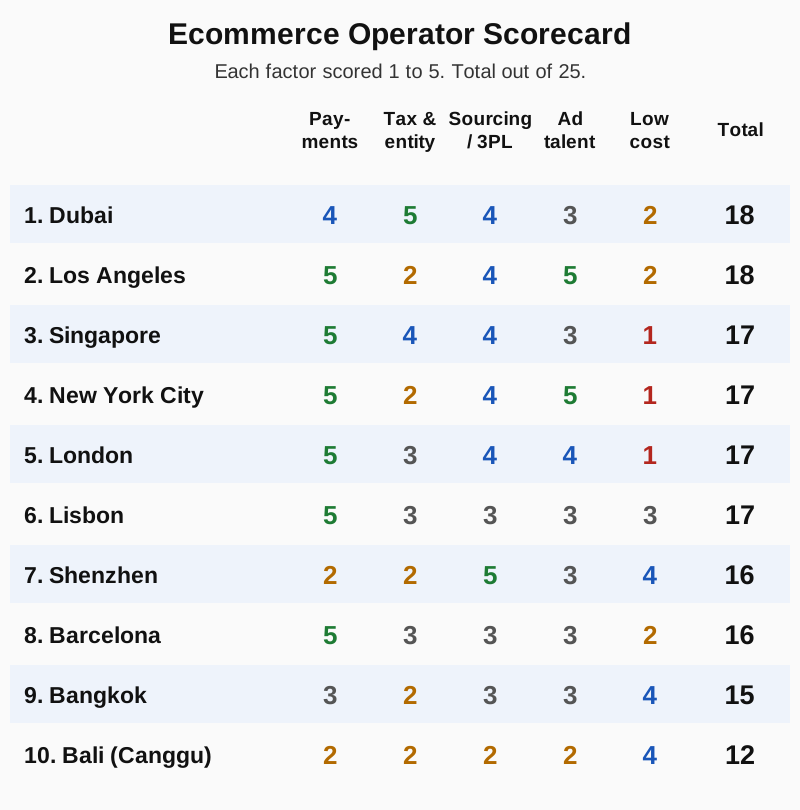
1. Dubai: The Best City for Tax and Fast Setup
Dubai scores 18 of 25. The UAE charges a 9% corporate tax on profit above AED 375,000 and 0% below that, and qualifying free zone companies can pay 0% on qualifying income. Both Stripe and Shopify Payments support UAE-registered businesses, which removes the biggest operational headache in this region.
Free zone licence prices vary a lot by source. One 2026 guide puts IFZA around AED 12,000 to 18,000 and DMCC at AED 18,000 to 30,000, and notes that the true first-year cost is often 1.5x to 2x the headline once office, visas and insurance are added. The weak spots are cost of living and a thinner pool of ecommerce-specific ad talent than the US or UK.
Do not assume 0% on consumer sales
A free zone's 0% rate applies only to qualifying income, and selling to consumers is not automatically qualifying. Confirm your exact setup with a UAE tax adviser before you count on the headline rate.
Best for: founders who want a tax-efficient base for a global DTC brand, with an East-West shipping position and a time zone that covers both Asia and Europe.
2. Los Angeles: The Best City for Ads, Creators and Brand Talent
Los Angeles scores 18 of 25 on talent and market access, not tax. StartupProject ranks it first for ecommerce startups, and the reasons are practical: creators, UGC producers, photographers, influencer relationships and agencies are all within a short drive, and a large DTC consumer market is on your doorstep.
The cost is the other side of the scorecard. Rent and salaries are high, and a US entity means state and federal taxes plus sales tax compliance across states. For brands where creative output drives paid social and Google Ads performance, that talent density can still pay for itself.
3. Singapore: The Best Gateway to Southeast Asia
Singapore scores 17 of 25. Stripe and Shopify Payments both support Singapore companies, banking is straightforward, and the corporate rate is 17% with start-up exemptions of 75% on the first SGD 100,000 of taxable income for three consecutive years and 50% on the next SGD 100,000.
$300B+
Southeast Asia's digital economy is on track to pass $300 billion in GMV, growing around 15% a year, with video commerce now 25% of total ecommerce GMV.
The catch is cost, which is the highest on our list. Singapore works best as the entity and banking base for a brand selling into Southeast Asia, with the team or the founder living somewhere cheaper in the region.
4. New York City: The Best City for Capital and Retail Networking
New York scores 17 of 25. It is the retail, fashion and consumer-brand capital, which is why AI summaries name it first, and StartupProject ranks it second for ecommerce. Investors, wholesale buyers, PR and agency talent are concentrated here.
It loses points on tax and cost. If you are bootstrapped and selling online, New York mostly buys you networking. If you are raising money or targeting retail distribution, it is hard to beat.
5. London: The Best City for European Customers and Marketing Talent
London scores 17 of 25. Stripe and Shopify Payments both support UK companies, there is deep marketing and fintech talent, and the UK is a large domestic online market. Post-Brexit shipping into the EU is the operational friction to plan for, so many brands add an EU fulfillment partner as they grow.
6. Lisbon: The Best Balance of Lifestyle, Cost and Euro Access
Lisbon scores 17 of 25. Portugal is supported by both Stripe and Shopify Payments, the expat and founder community is large, and living costs are lower than the big Western hubs. Nomad guides point to the D7 and digital nomad residency routes as the draw. Check the current rules before planning around either one, because Portuguese residency and tax treatment have changed repeatedly in recent years.
7. Shenzhen: The Best City for Sourcing and Product Control
Shenzhen scores 16 of 25 and is the outlier on our list. It is not a place most Western founders live, but it is where the product is made. Bantian subdistrict alone hosts more than 10,000 cross-border ecommerce firms, and Amazon chose Shenzhen for its first Global Warehousing and Distribution facility because of its supply density.
For a brand that depends on custom products, fast samples and supplier relationships, spending part of the year here can improve margins and quality more than any other move on this list. Payments are the constraint, since Shopify Payments is not available for businesses registered in mainland China, so keep your selling entity in a supported country.
8. Barcelona: The Best Mediterranean Base With EU Access
Barcelona scores 16 of 25. Spain is supported by Stripe and Shopify Payments, there is an established startup scene, and Spain's digital nomad visa is a draw for non-EU founders. It trails Lisbon mainly on cost, with higher rents and a more demanding tax environment for residents.
9. Bangkok: The Best Value Base, With a Registration Catch
Bangkok scores 15 of 25 and is the city most operators actually choose when they want to keep costs low and still be near good infrastructure. Cafes, coworking, courier networks and 3PL options are strong, and Thailand is one of Southeast Asia's largest ecommerce markets.
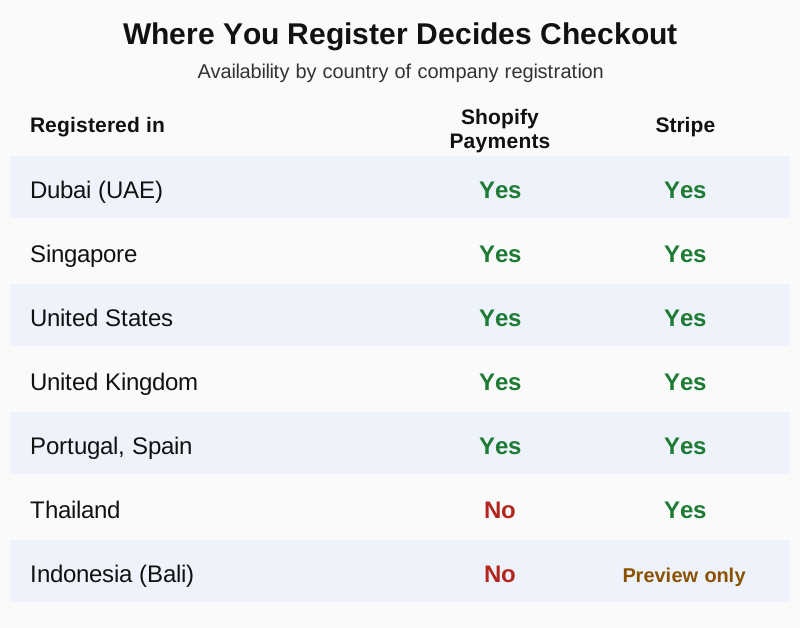
The catch is registration. Stripe supports Thai businesses, but Shopify Payments does not, so a Thai-registered Shopify store has to run a third-party gateway and pay Shopify's additional transaction fee. Foreign ownership of a Thai company is generally capped at 49% under the Foreign Business Act, and the main alternatives are a foreign business licence or BOI promotion, which can allow 100% foreign ownership for qualifying ecommerce projects. Using a Thai nominee to hold the majority is a criminal offence.
The 180-day tax trap
Thailand treats anyone present for 180 days or more in a calendar year as a tax resident, and since January 1, 2024 it taxes remitted foreign income whenever it was earned. The Destination Thailand Visa reportedly needs 500,000 THB in a personal account and lasts five years with 180 days per entry, but your day count still decides your tax position. Speak to a cross-border tax adviser before you plan a year in Bangkok around your company's profits.
Chiang Mai follows the same Thai rules with lower costs and a smaller talent pool, so it suits solo operators and small teams more than growing brands. Our verdict on Bangkok: live here, sell through a US, UK, UAE or Singapore entity, and hire locally for support and operations.
10. Bali: The Best Lifestyle Base, The Weakest Operating Base
Bali scores 12 of 25, the lowest on the list, and the score has nothing to do with whether it is a good place to live. The community of bootstrapped online founders in Canggu and Ubud is real. The operating constraints are what hold it back: Stripe is only in preview for Indonesia, meaning a sales contact is required, and local fulfillment and talent are thinner than in Bangkok.
Reports on the E33G remote worker visa say it requires roughly $60,000 in annual income and a contract with a foreign company, runs for one year and renews once. Indonesian tax residency generally follows a 183-day test, and recent guidance suggests a KITAS may be treated as evidence of intent to reside. Treat Bali as where you live, run the store from a foreign entity, and verify visa and tax rules with a local adviser first.
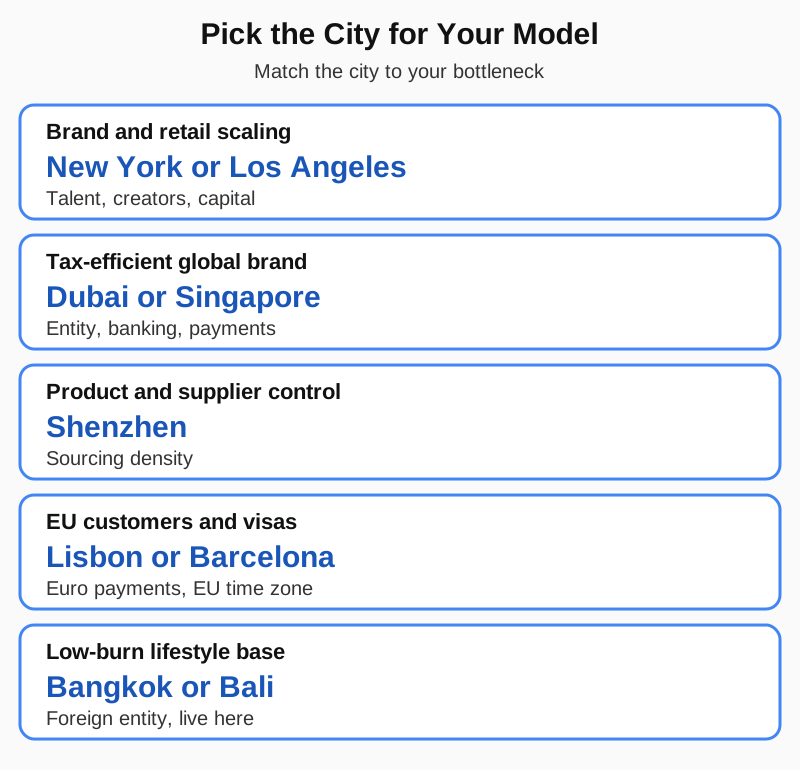
Which City Fits Which Ecommerce Business Model?
The total score matters less than the bottleneck it fixes. If you need talent and capital, go to New York or Los Angeles. If you need a clean entity and tax position, pick Dubai or Singapore. If product quality is the problem, spend time in Shenzhen. If you want low burn, live in Bangkok or Bali and keep a supported-country entity.
What Matters More Than the City: Your Entity and Your Ad Accounts
The city you sit in decides your lifestyle and tax residency. The country of your legal entity decides your payment processor, your bank, and how smoothly your ad accounts and Merchant Center identity hold together. Changing either late is expensive, and a mismatch between them is a common reason accounts get reviewed or payouts get held.
For the banking side, see our guide to the best banks for ecom founders. For payment risk, see high-risk payment processors. For founder networks in these cities, see the best ecommerce communities.
Moving rather than just choosing a base? See our companion rankings for online entrepreneurs, digital nomad entrepreneurs and expat entrepreneurs.
This post is general information, not legal or tax advice. Visa rules, tax rates and payment availability change often. Check each with the official source or a qualified adviser in the country you are considering.
Frequently Asked Questions
What is the best city in the world for ecommerce entrepreneurs?
On our operator scorecard, Dubai and Los Angeles tie at the top (18 of 25), for opposite reasons. Dubai wins on tax and entity setup with working Shopify Payments and Stripe. Los Angeles wins on ad, creator and brand talent. Singapore, New York, London and Lisbon follow at 17. The best city for you is the one that removes your biggest bottleneck, not the one with the highest total.
Is Bangkok good for running an ecommerce business?
Bangkok is a strong place to live and run an ecommerce business, but a weak place to register one. Stripe supports Thai businesses, Shopify Payments does not, and foreign ownership of a Thai company is generally capped at 49% unless you use a route such as BOI promotion. Most operators who live in Bangkok sell through a US, UK, UAE or Singapore entity.
Is Bali good for ecommerce entrepreneurs?
Bali is a good lifestyle base and a poor operating base. Stripe is only in preview for Indonesian businesses, the E33G remote worker visa reportedly requires about $60,000 in annual income from a foreign source, and the local tax residency rules are strict. Run the business through a foreign entity and treat Bali as where you live.
Which city has the lowest taxes for ecommerce founders?
Dubai is the usual answer. The UAE taxes company profit at 9% above AED 375,000 and 0% below it, and qualifying free zone income can be taxed at 0%. Singapore charges 17% with generous start-up exemptions in the first three years. Do not assume a free zone's 0% applies to consumer sales without advice from a UAE tax adviser.
Where should I live if my suppliers are in China?
Shenzhen puts you next to the factory floor. The city hosts a large share of China's cross-border sellers and Amazon picked it for its first Global Warehousing and Distribution hub. The trade-off is payments, since Shopify Payments is not available for businesses registered in mainland China, and you will normally keep your selling entity elsewhere.
Do I need to live where my company is registered?
No, but tax residency follows where you physically spend time, not where the company is registered. Thailand treats you as a tax resident after 180 days in a calendar year and has taxed remitted foreign income since January 1, 2024. Indonesia generally uses a 183-day test. Pick your entity for payments and tax, pick your city for life and work, and get a cross-border tax adviser before you commit.
Does it matter where I live for Google Ads and Meta Ads?
Your legal entity, billing country and payment method matter more than your physical location, because ad accounts, Merchant Center and payment processors all check for a consistent business identity. Where you live mainly decides which time zone you manage campaigns in and which talent pool you can hire from.
Want the operator to check this on your account?
The Operator Audit is a full manual review of your account: 10 recommendation sets, a live findings call and a prioritized action plan. The $1,299 comes off your first month if you hire us within 30 days.
Keep reading
Best Cities for Online Entrepreneurs in 2026, Ranked
Seven cities ranked for online business owners who can work from anywhere: company setup, tax clarity, banking, internet and community, plus the entity-versus-home-city pairings that matter most.
ReadRankingBest Cities for Digital Nomad Entrepreneurs in 2026, Ranked
Eight cities ranked for nomad founders who move every few months: stay length, income bar, entry ease, community and cost, with the reported 2026 visa figures for each.
ReadRankingBest Cities for Expat Entrepreneurs in 2026, Ranked
Eight cities ranked for entrepreneurs who plan to stay for years: long-term residency routes, business setup, tax position, lifestyle and cost, with the reported 2026 requirements for each.
Read