AI UGC Video Generator Systems for Ecommerce Brands: What Actually Works in 2026
Real UGC creators cost $300-500 a video and take two weeks. Most AI UGC attempts look robotic and tank ad performance instead of saving money. Here's what an actual AI UGC production pipeline requires, and an honest look at the Anti-Slop AI UGC System built to fix it.
Every ecom brand running paid social hits the same wall eventually: you need a constant stream of UGC-style video ad creative, and the two ways to get it both have a real cost.
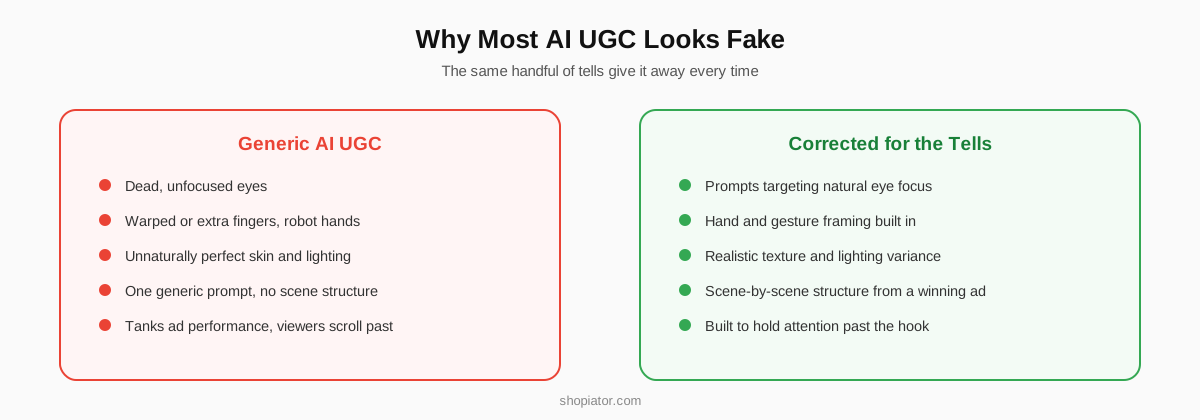
Hire real creators and you're paying $300 to $500 a video with a one to two week turnaround, before you even know if it converts. Try to generate it with AI instead and most of what comes out looks exactly like what it is: dead eyes, robot hands, skin that's too smooth, lighting that's too perfect.
Viewers scroll past it in under a second, and it can actively hurt performance by reading as an ad the moment it starts. Neither problem is really about the tool. It's about whether there's an actual system behind the video, not just a prompt.
What "AI Slop" Actually Looks Like, and Why It Tanks Ad Performance
The entire reason UGC-style ads outperform polished brand creative is that they don't pattern-match as ads. The moment a viewer's brain flags something as "produced," the scroll-past reflex kicks in.
Most first-attempt AI UGC gets flagged even faster than a bad human-shot ad, because AI video has its own specific tells: unnaturally symmetrical faces, hands that render wrong under motion, lighting with no real-world light source, and expressions that hold a fraction too long or shift a fraction too fast.
None of that is a model-quality problem you fix by switching video generators. It's a prompting and correction problem, and it requires knowing what those specific tells are so you can prompt against them directly instead of hoping a better model quietly fixes it.
What an Actual AI UGC Production Pipeline Requires
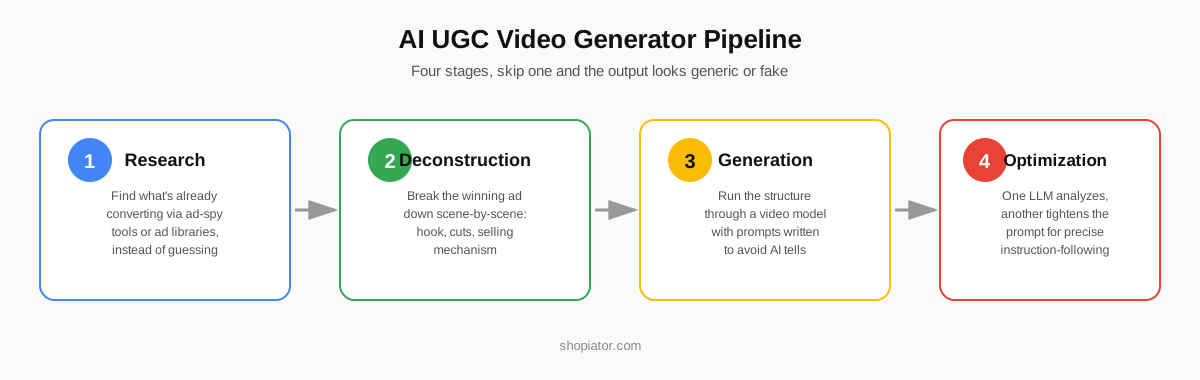
A single prompt typed into a video model isn't a system, it's a guess. A real pipeline has four distinct stages, and skipping any of them is usually why the output looks generic or fake.
- ▶Research: find what's already converting, using an ad-spy tool like KALO DATA or just the Facebook and TikTok Ads Libraries directly, instead of inventing a concept from nothing
- ▶Deconstruction: break a winning ad down scene-by-scene, what changes at each cut, what the hook does in the first two seconds, what the actual selling mechanism is, before writing a single generation prompt
- ▶Generation: run the deconstructed structure through a current video model (Higgsfield, Kie.ai, and Sora are the names worth knowing right now) with prompts written to specifically avoid the tells covered above
- ▶Prompt optimization: use an LLM to do the deconstruction and prompt-tightening work, a model strong at analysis (Gemini is commonly used here) for the breakdown, and a model strong at precise instruction-following (Claude) to turn that analysis into a clean generation prompt
The Anti-Slop AI UGC System: What's Actually Inside
The Anti-Slop AI UGC System, built by Marketing Mafia on Whop, is one of the more specific attempts at packaging this exact pipeline.
It runs $148/month, has 793 members at time of writing, and holds a 4.8-star rating across 54 reviews, 94% of them five stars.
- ▶A prompting framework built specifically around avoiding the visual tells that read as AI-generated
- ▶The scene-by-scene breakdown method for deconstructing winning ads before generating anything
- ▶20+ copy-paste prompt templates as a starting point, not the whole system
- ▶Training on Higgsfield and Kie.ai as the primary generation tools
- ▶A build-your-own "UGC Deconstructor" workflow in Gemini and a "Sora Prompt Optimizer" workflow in Claude
- ▶The competitor research method using tools like KALO DATA and the Facebook Ads Library to find what to reverse-engineer in the first place
$148/month. 793 members, 4.8 stars across 54 reviews. The scene-by-scene breakdown method, 20+ prompt templates, and the Gemini/Claude prompt-optimization workflow above.
Get the Anti-Slop AI UGC SystemThe listing has 54 reviews at a 4.85 average, and the actual spread is worth reading past the headline number, both the praise and the pushback:
“Best AI course. Did struggle with one thing that was crucial for a long time, and it's fixed. Insane prompts also.”
footyskiller
“Great course, very detailed with some golden nuggets I haven't seen elsewhere.”
bogaczek
“Great course and communication. Everything with AI seems so overwhelming with new tools coming out like almost every week so it's easy to get lost in the sauce, but 0xRoas really comes in clutch to help marketers get up to speed to use AI content creation. His patience and willingness to help is what makes this course even better. Highly recommended!”
burneracct
“Honestly courses like this, i dont want to people know of, like full of sauce around Ai UGC, You just need good script in this thats it, implementation is very easy couple of generation you will be pro”
Aman Kr Chaurasia
“its ok. not super detailed or well structured. likely just pasted directly from ChatGPT.”
Victor Fedotov
“Would not recomend. About 40minutes of Videos”
Marvin
That's a genuine mix, not a cherry-picked highlight reel: the critical reviews call out thin structure and short total video runtime, which lines up with this being a focused prompt-and-workflow system rather than an exhaustive course. Worth weighing against the $148/month price before signing up.
Who This Is Actually For
This makes sense for a brand already spending real money on human UGC creators, currently paying $300-500 per video with a multi-week turnaround, and wanting to test whether AI-generated variants can absorb a chunk of that volume at a much lower per-video cost. It does not replace creative strategy or testing discipline.
$148/month is real, recurring money, and it's only worth it if you're actually going to produce and test enough video volume to make the per-video cost work out below what a human creator would have charged for the same output.
Disclosure
The link to the Anti-Slop AI UGC System above is an affiliate link. We may earn a commission if you sign up through it, at no extra cost to you. This does not mean we are open to paid placements or collaborations at this time. Everything described above is based on our own review of the product's public listing, its actual FAQ answers, and its published reviews, not vendor-supplied copy.
$148/month. 793 members, 4.8 stars across 54 reviews. The scene-by-scene breakdown method, 20+ prompt templates, and the Gemini/Claude prompt-optimization workflow covered above.
Get the Anti-Slop AI UGC SystemFrequently Asked Questions
Will AI UGC just make more of the same fake-looking AI videos?
Not if the system is actually built to avoid it. The tell is whether it specifically targets the handful of visual signals that make AI video read as fake at a glance, dead eyes, robot hands, unnaturally perfect lighting and skin, rather than just generating a clip and hoping it passes. A prompting approach that doesn't name and correct for these specific failure points will keep producing the same obviously-AI output no matter how many times you regenerate it.
Do I need to be a creative genius to come up with ad ideas for AI UGC?
No, and this is where most people waste time trying to invent concepts from scratch. The more reliable approach is finding what's already converting for competitors or adjacent brands using an ad spy tool (KALO DATA is one) or the Facebook and TikTok Ads Libraries directly, then reverse-engineering the structure of what's already working instead of guessing at a new concept.
What tools do I actually need for AI UGC video generation?
At minimum, a video generation model, current options worth knowing include Higgsfield, Kie.ai, and Sora, plus a prompting layer on top of it. The generation model alone isn't the system: you also need something that deconstructs a winning ad scene-by-scene (an LLM like Gemini works for this) and something that optimizes and tightens the actual prompts you feed the video model (Claude is commonly used here). The tools without that middle layer just produce generic output.
Is AI UGC really a repeatable system, or just a collection of prompts?
A prompt library alone isn't a system, it's a starting point that goes stale as models update. A real system is the process: find winning ads, break them down scene-by-scene, translate that structure into a prompt using a consistent framework, generate, and iterate. The prompts are the output of that process, not the process itself.
Why can't I just use ChatGPT for AI UGC ad creative?
A single general-purpose chatbot tends to give generic, safe output because it's not specialized for either half of the job. A more effective setup uses different models for different jobs, one strong at video/creative analysis to reverse-engineer what's working, and a separate one strong at precise instruction-following to turn that analysis into a tight generation prompt. Stacking tools this way consistently outperforms asking one general model to do both jobs at once.
P.S. If you're also looking to scale on Google Ads, book a 30-minute call with the founder, no pitch, just a look at your account.
Keep reading
How to Take Down Ecom Copycats and File a DMCA the Right Way (2026 Guide)
Launch an ecom brand without a registered trademark and copycats will find you on Amazon and clone your domain within months. Why trademark timing matters, how to actually take copycats down, and how to fight back if one wrongly DMCAs you.
ReadGuideHow Meta Agency Ad Accounts Actually Work (and When You Actually Need One)
A Meta agency account isn't immunity from bans, it's borrowed trust you're renting. Here's what actually triggers a restriction, what an agency account structurally changes, the risk the sales pitch skips, and how to know if you need one.
ReadGuideSingle-Platform Specialist or Multi-Platform Generalist? The Real Agency Ad Account Decision
The real decision behind an agency ad account isn't which provider has the best reviews. It's whether you want deep trust concentrated on one platform, or one relationship spread thinner across several. Here's how to actually choose.
Read