How to Lower Your Chargeback RateA Prevention System for Ecom Brands

By Santosh Kumar, Founder of Shopiator
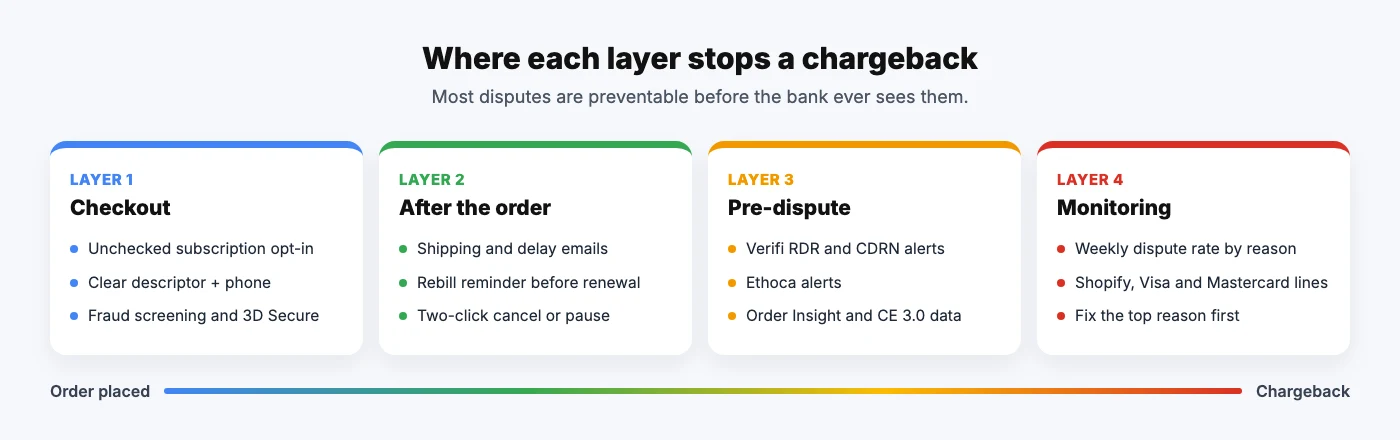
A four-layer system to stop chargebacks before they happen: clear subscription consent and descriptors at checkout, rebill reminders and easy cancels after the order, RDR, Ethoca and CE 3.0 before the dispute, and the Shopify, Visa and Mastercard lines to monitor.
A store owner in an ecom group asked a simple question this week: how do you lower your chargeback rate, or stop chargebacks before they happen? Is there a system?
There is. Most chargebacks are not fought and lost in a bank's back office. They are created weeks earlier, by a checkbox, a confusing statement line, a missing shipping email, or a cancel button nobody could find. Fix those, catch the rest before they become disputes, and watch the right numbers.
1.5%
90-day chargeback rate at which Shopify can automatically enroll a store in its Network Dispute Resolution Program, with a $15 fee per dispute and a 10% payout reserve.
Source: Shopify Help Center
Why Chargebacks Happen in the First Place
Start with the reason codes in your own disputes, because the fix depends on the cause. Industry data points the same way: in Chargeback.io's alert data, Visa 10.4 (card-absent fraud) led at 11.1%, followed by 13.2 (cancelled recurring transaction) at 8.5% and 13.7 (cancelled merchandise or services) at 8.2%. Chargebacks911's 2026 Field Report puts friendly fraud at 43.8% of chargebacks.
- ▶True fraud: a stolen card was used. Fix it at checkout with screening and 3D Secure.
- ▶Subscription surprise: the customer did not realize they signed up, or could not cancel. Fix consent and cancellation.
- ▶Did not recognize the charge: the statement line meant nothing to them. Fix the descriptor.
- ▶Item not received or not as described: slow or silent shipping, or a product page that oversold. Fix communication and copy.
- ▶Friendly fraud: the customer got the product and disputes anyway. Fix it with evidence and alerts, because you cannot design it away completely.
Layer 1: Checkout, Where Most Disputes Are Created
Get real consent for subscriptions
The single biggest self-inflicted cause is the pre-checked subscribe box, often with the renewal price in tiny gray text. It converts better for a month, then comes back as refunds and disputes when the first rebill lands.
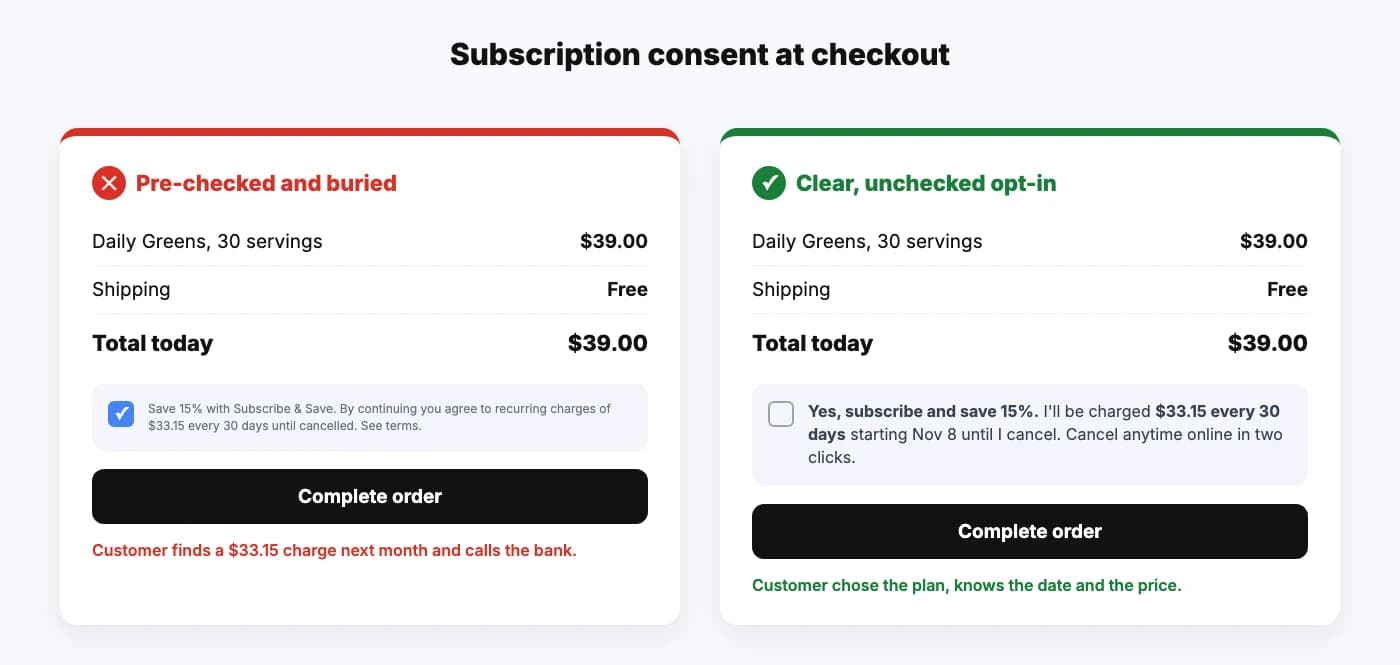
- ▶Leave the box unchecked and make subscribing an active choice.
- ▶Put the renewal terms next to the box: amount, frequency, first rebill date and how to cancel.
- ▶Send a confirmation email that repeats those terms and links to self-serve cancellation.
- ▶Keep proof of consent. California's automatic renewal law, amended from July 1, 2025, requires express affirmative consent and records of it for at least three years or one year after termination, whichever is longer.
On the federal side, the FTC's click-to-cancel rule was vacated by the Eighth Circuit on July 8, 2025, and the FTC reopened rulemaking in March 2026. That does not make dark patterns safe: ROSCA enforcement and state laws still apply, and a confused subscriber disputes regardless of what the law says.
Make your billing descriptor recognizable
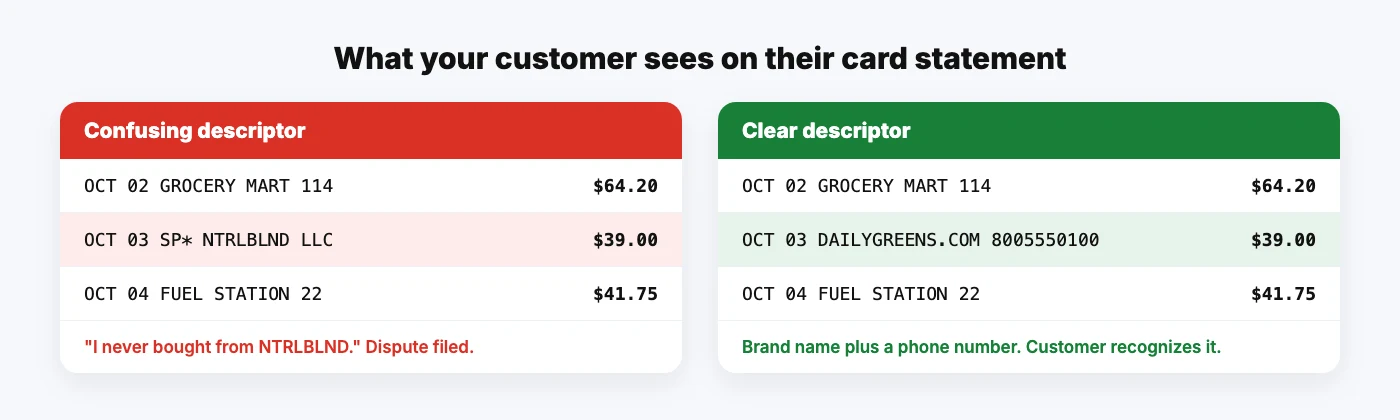
If the statement line does not match the brand the customer remembers, they call the bank instead of you. Set a descriptor with your store name or domain and a phone number, and keep it consistent across processors.
Screen for fraud and use 3D Secure on risky orders
Card-absent fraud is the single largest reason code. Use your platform's risk scoring, review or hold high-risk orders before you ship, and force a 3D Secure challenge on large or risky orders. On Whop, payment rules let you block, hold or challenge by risk score, amount, card country or IP. Screen on order signals, never on a customer's demographics or neighbourhood.
Layer 2: After the Order, Before the Bank
Between purchase and the next statement, silence is what turns a customer into a disputer. Fill it.
- ▶Shipping updates, including delays. Tell customers before they have to ask. A proactive delay email prevents more item-not-received disputes than any evidence packet wins.
- ▶Set expectations on results. For products that take weeks to work, send usage guidance between the order and the first rebill.
- ▶Rebill reminder before every renewal, with the date, amount and a link to pause, skip or cancel.
- ▶Two-click cancel or pause. If cancelling is harder than calling the bank, customers call the bank. California's amended law also requires online cancellation for online sign-ups.
- ▶A real, fast support channel. Put your support email or chat on the order confirmation, the shipping emails and your descriptor.
Refunding quickly is cheaper than losing a dispute. A refund costs the sale. A chargeback costs the sale, a dispute fee and a point on your rate, whether or not you win it.
Layer 3: Catch Disputes Before They Are Filed
Some customers will go to the bank anyway. Pre-dispute tools give you a chance to refund or resolve before it becomes a chargeback on your record.
| Tool | Network | What it does |
|---|---|---|
| Verifi RDR | Visa | Refunds qualifying Visa disputes automatically, under rules you set in advance |
| Verifi CDRN | Visa, some others | Sends a pre-dispute alert you resolve, usually with a refund |
| Verifi Order Insight | Visa | Shares order details with the issuer so the cardholder recognizes the purchase |
| Ethoca alerts | Mastercard, mostly | Sends a pre-dispute alert you resolve, usually with a refund |
| Compelling Evidence 3.0 | Visa | Uses prior undisputed purchases to block or reverse friendly fraud disputes |
Alert coverage for American Express and Discover is limited, and alerts do not cover PayPal, Klarna, Affirm or other non-card methods.
Two cautions. RDR refunds automatically, so set its rules carefully: too loose and you refund disputes you would have won. And CE 3.0 only helps with Visa card-absent fraud disputes (10.4) where the same card has two prior undisputed transactions 120 to 365 days old with matching data, including the IP address or device ID. It does nothing for a brand-new customer, and it only works if your processor passes those data points.
For the software that runs this layer, including Disputifier, Chargeblast and the enterprise platforms, see our ranking of the best chargeback prevention software.
If you process on Whop, the tools are built in
Brands taking payments through Whop get this layer without a separate app. Per Whop's dispute docs:
- ▶Early dispute alerts (RDR): a warning before the dispute becomes official, at $29 per alert, with automatic refunds below a threshold you set. New accounts start with auto-refunds under $500.
- ▶Dispute Fighter: when a dispute lands, Whop submits customer details, the purchase and access log, and your cancellation and refund policies as evidence automatically. You add receipts, chats and proof of delivery before the deadline.
- ▶Resolution Center: customers can raise a problem with you before going to their bank, and Whop decides if you do not reply within 7 days.
- ▶Payment rules: block, hold or force 3D Secure by risk score, amount, card country or IP. See Whop payment rules.
Two limits to know: Whop's docs do not say whether its alerts cover Mastercard as well as Visa, and its seller terms ask you to keep the dispute rate below 1%, with reserves or suspension if it climbs.
Layer 4: Monitor the Lines That Matter
Your processor and the card networks each watch your dispute rate. Know where the lines are, and keep a buffer under all of them.
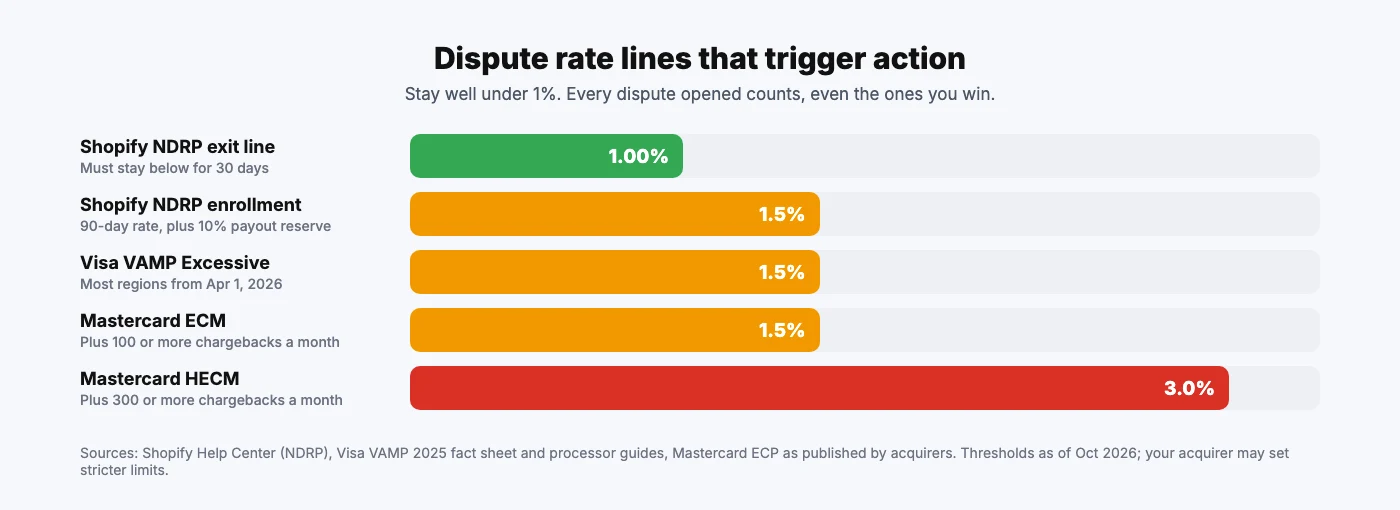
- ▶Shopify: a 90-day rate of 1.5% or higher can auto-enroll you in its Network Dispute Resolution Program, with a $15 US fee per auto-resolved dispute and a 10% payout reserve. Exit requires staying below 1.00% for 30 consecutive days. Track it in Settings, Payments, Chargeback monitoring.
- ▶Visa VAMP: the merchant Excessive line dropped from 2.2% to 1.5% on April 1, 2026 in most regions, for merchants above the monthly event minimum. It combines fraud reports and disputes.
- ▶Mastercard ECP: Excessive Chargeback Merchant at 100 to 299 chargebacks and a 1.5% to 2.99% ratio in a month, High Excessive at 300+ and 3%+, with fines that escalate each month.
Review disputes weekly by reason code, product and traffic source. A spike tied to one product, one offer or one ad angle usually points straight at the fix. If an ad promises more than the product delivers, the dispute rate is where you see it first.
Tactics to Skip
- ▶Profiling customers by zip code, income or demographics. It carries discrimination risk and does not target the actual fraud signals. Use order-level risk data instead.
- ▶Switching off card brands as a first move. Weaker alert coverage on American Express and Discover is real, but cutting them costs sales. Fix causes first.
- ▶Hiding the cancel button or the renewal price. It inflates next month's revenue and this quarter's dispute rate.
- ▶Relying on winning disputes. On Shopify, a won dispute still counts toward your rate.
A Weekly Chargeback Checklist
- 1.Check your 90-day dispute rate against the 1% buffer and the 1.5% lines.
- 2.Sort new disputes by reason code and fix the top cause.
- 3.Confirm every subscription offer uses an unchecked opt-in with the terms beside it.
- 4.Spot-check that rebill reminders and shipping delay emails actually sent.
- 5.Review alert refunds from RDR, CDRN and Ethoca for rules that are refunding too much.
- 6.Read five recent disputes in full. The customer's own words usually name the problem.
Chargebacks also limit how hard you can scale paid traffic, because a processor reserve or a suspended Merchant Center stops growth faster than any bad campaign. If your ads are part of the problem, see why ecom brands fail at Google Ads and how to keep Google Ads accounts out of policy trouble.
Frequently Asked Questions
Does Whop offer chargeback protection?
Whop has built-in dispute tools rather than a guarantee: early dispute alerts (RDR) at $29 each with automatic refunds below a threshold you set, Dispute Fighter that submits customer, access and policy evidence automatically, a Resolution Center for customer complaints, and payment rules for fraud screening. Disputes still cost the amount plus a $15 fee.
What is a good chargeback rate for an ecom store?
Stay well under 1% of transactions. Shopify can automatically enroll a store in its Network Dispute Resolution Program at a 1.5% rate over 90 days, and Visa's VAMP and Mastercard's ECM programs also start at 1.5% in most regions. Every dispute opened counts toward the rate, including the ones you win.
What happens if my Shopify chargeback rate gets too high?
Per Shopify's Help Center, a 90-day chargeback rate of 1.5% or higher can trigger automatic enrollment in its Network Dispute Resolution Program. Disputes are then refunded automatically with a $15 US fee each, and a 10% reserve is applied to payouts. To exit, the rate must drop below 1.00% and stay there for 30 consecutive days.
Are pre-checked subscription boxes allowed?
They are a major source of subscription chargebacks and a legal risk. California's automatic renewal law, amended from July 1, 2025, requires express affirmative consent to renewal terms and proof of it, and regulators treat pre-checked boxes as not meeting that bar. The FTC's click-to-cancel rule was vacated in July 2025, but ROSCA and state laws still apply.
What is the difference between RDR and Ethoca alerts?
Verifi, owned by Visa, runs RDR, which refunds qualifying Visa disputes automatically under rules you set, and CDRN, which sends alerts you resolve. Ethoca, owned by Mastercard, sends alerts mostly for Mastercard disputes. Coverage for American Express and Discover is limited, and alerts do not cover PayPal or buy now pay later payments.
Does Compelling Evidence 3.0 work for new customers?
No. CE 3.0 applies to Visa card-not-present fraud disputes (reason code 10.4) and needs two prior undisputed transactions on the same card, 120 to 365 days old, with matching data that includes the IP address or device ID. It helps most with repeat and subscription customers.
Is the FTC click-to-cancel rule in effect?
No. The Eighth Circuit vacated it on July 8, 2025, and the FTC opened a new rulemaking in March 2026. Subscription sellers still face ROSCA enforcement and state automatic renewal laws such as California's, so clear consent and easy cancellation remain the safe default.
Should I disable American Express to avoid chargebacks?
Usually not. Alert coverage for American Express and Discover is weaker, but turning off card brands costs sales. Fix the causes first: consent, descriptors, delivery communication and cancellation. Only consider it if one brand drives a disproportionate share of your disputes.
Want the operator to check this on your account?
The Operator Audit is a full manual review of your account: 10 recommendation sets, a live findings call and a prioritized action plan. The $1,299 comes off your first month if you hire us within 30 days.
Disclosure: Shopiator has a referral relationship with Whop and may earn a commission if you sign up through the links on this page, at no extra cost to you. We do not operate, control or guarantee any provider or tool mentioned here, so do your own due diligence.
Keep reading
Google Dropshipping Is a Goldmine? An Operator's Honest Take
Is Google dropshipping a goldmine? Intent is not demand for your store: Amazon, Walmart, Temu and Shein sell the same product, and Merchant Center Misrepresentation suspensions end many stores. An operator's honest take.
ReadGuideWhy Whop? What It Does and Who It's Actually For
Why Whop: payments in 195 countries, no monthly fee, built-in affiliates, BNPL, memberships, and stores. Fees, honest downsides, and who should use it.
ReadRankingBest 3PL Providers for Ecommerce (2026): What Operators Actually Use
The US 3PLs ecom operators actually recommend in 2026: Shipdudes, ShipMonk, Manifest.eco, Zendrop, ShipBob, FulfillEasy and Mina, with what each one is good at, the complaints, and what to ask before you sign.
Read