Last updated: September 27, 2026
We Monitored 26 DTC Google Ads AccountsHere's What Actually Breaks
Six months of daily monitoring data from 26 DTC and ecommerce Google Ads accounts, March to September 2026. Product-level problems outnumber account-level ROAS problems roughly 10 to 1, 18% of Shopping and PMax product spend goes to products that don't convert or convert at under half of target, and two in three accounts had changes made by someone outside the managing team. First-party data, anonymized, rates and percentages only.
The headline ROAS number is the least interesting thing in a Google Ads account. Across six months of daily monitoring on 26 DTC and ecommerce accounts, the problems that actually cost money sat one level down: individual products burning budget, and changes nobody on the managing team made.
This is first-party data from the monitoring system we run on the accounts we manage, not a survey or a scraped roundup. Every figure is a rate or a percentage, never a raw spend or revenue figure, and no account is identifiable.
Methodology
The data comes from the monitoring system that runs daily on every Google Ads account Shopiator manages. It stores account-level daily performance, a daily 30-day product performance snapshot for Shopping and Performance Max, performance alerts, and the account's change history pulled from the Google Ads API.
The dataset covers 26 DTC and ecommerce accounts from March 12 to September 26, 2026. Accounts that are no longer managed by us and non-ecommerce accounts were excluded. Each finding states how many accounts it draws on, because not every account runs every campaign type. ROAS is measured by conversion time (conversion value attributed to the day of the click), not by reporting date. No account names, domains, IDs or raw spend and revenue figures appear anywhere in this piece.
Product-level problems outnumber account-level ones roughly 10 to 1
Of every performance alert the system raised across 26 accounts, 88% were product-level: a single SKU with a CPC far above the account norm, a ROAS well under target, or spend with no conversions at all. Account-level alerts, meaning ROAS drops, cost spikes and sustained declines across the whole account, made up about 8%. The remaining 4% were positive signals, campaigns beating target with room to scale.
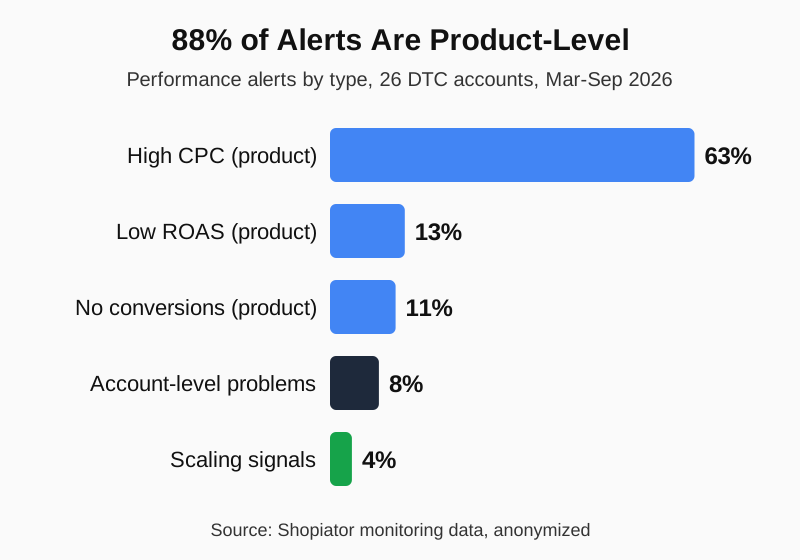
Product-level alerts fired in 21 of the 26 accounts, nearly every account running Shopping or Performance Max. That's the practical point: if you only watch the account ROAS, you are watching the one number that almost never breaks.
18% of product spend was doing little or nothing
In the latest 30-day product snapshot across 22 ROAS-target accounts, 13% of all product-level spend went to products with zero conversions in the window. Another 5% went to products that did convert, but at under half of the account's target ROAS.
Pooled across accounts that's roughly one dollar in six, and the typical account was worse: the median account had a quarter of its product spend on zero-conversion products. Some of that is deliberate, because feeder campaigns exist to spend on discovery, but most of it is exactly what a weekly SKU review should catch. The account-level ROAS was on target in most of these accounts at the same time, because a handful of strong products carried the average. Nothing in the headline number tells you the leak is there. For the structural fix, see our Shopping feeder and converter architecture and the product-level checks in our wasted spend checklist.
Most accounts hit target ROAS. The margin is the story.
Of 15 ROAS-target accounts with meaningful spend in the last 30 days, 11 (73%) beat their target by conversion time. Two of the four misses were within 25% of target. The other two were small accounts spending under $10K a month.
That's a healthier baseline than the industry narrative allows for, and it's exactly why the product-level finding matters. Hitting target is not the same as spending well: an account can beat target ROAS while one dollar in six goes to products that shouldn't be getting it.
Two in three accounts were changed by someone outside the managing team
Over the six months, 16 of 25 accounts with change history (64%) had at least one edit made by someone other than the managing team, and those outside edits were 8.6% of all logged changes. In practice that's the brand's own team, a past freelancer who still has access, or a connected app.
None of that is wrong by default. The brand owns the account and should have access. The risk is that nobody reconciles it: a budget raised on a Friday or a campaign paused from a phone becomes an unexplained swing in next week's numbers. A weekly change-history review, and removing stale user access, closes that gap.
So what
The recurring theme is that the costly problems live below the headline. Product-level leaks and unreconciled changes don't show up in an account-level ROAS, and they don't fix themselves with more budget or a new campaign type. They get fixed when someone checks SKU-level performance and the change log every week.
If your account hasn't had a structural review in the last 60 to 90 days (bid strategy by campaign role, SKU-level Shopping and PMax performance, change history), there's a good chance at least one of these patterns is sitting in it now.
Data Source
Aggregated and anonymized from Google Ads accounts managed by Shopiator. No client names, account-level figures or raw spend, click or conversion totals are disclosed, only rates and percentages. We'll refresh this page as new data comes in.
Free Benchmark Report
Get the 2026 Ecom Google Ads Benchmark Report
- +Every finding broken down by monthly ad spend band
- +Product-level waste: pooled vs the typical account, per band
- +Who changes accounts, by account size
- +A 10-point self-audit scorecard to grade your own account
Frequently Asked Questions
What is the most common problem in an ecommerce Google Ads account?
Product-level waste. Across 26 monitored DTC accounts, 88% of all performance alerts were product-level (individual SKUs with a high CPC, low ROAS or no conversions), against about 8% for account-level ROAS drops, cost spikes and declines. That is roughly 10 product-level problems for every account-wide one.
How much Shopping and Performance Max spend is wasted on products that don't convert?
In the latest 30-day product snapshot across 22 accounts, 13% of product-level spend went to products with zero conversions, and another 5% went to products converting at under half the account's target ROAS. Roughly 18% of product spend was doing little or nothing, while the account-level ROAS still looked fine in most of those accounts.
What percentage of ecommerce Google Ads accounts hit their target ROAS?
11 of 15 ROAS-target accounts with meaningful spend (73%) beat their target on a trailing 30-day basis, measured by conversion time. Two of the four misses were within 25% of target, which points to tuning rather than a broken strategy.
How often do people outside the agency change a Google Ads account?
Two in three accounts (16 of 25) had at least one change made by someone other than the managing team over six months, and those outside edits were 8.6% of all logged changes. Usually it's the brand's own team, a past freelancer or a connected app. None of it is wrong by default, but every unlogged change is a variable nobody is tracking when performance moves.
Does a good account-level ROAS mean the account has no problems?
No. A healthy topline ROAS is an average, and averages hide losers. In this data the product-level leaks sat underneath accounts that were hitting target overall, which is why a structural audit checks SKU-level performance and the change log, not just the headline number.
How often should a Google Ads account be audited?
Product-level performance and the change history should be reviewed weekly, and a full structural audit (bid strategy per campaign role, feed, brand isolation) every 60 to 90 days. Product leaks and outside changes both accumulate quietly between reviews.
Want the operator to check this on your account?
The Operator Audit is a full manual review of your account: 10 recommendation sets, a live findings call and a prioritized action plan. The $1,299 comes off your first month if you hire us within 30 days.
Keep reading
PMax Architecture for DTC Brands: Feed-Only vs Full-Build
Feed-only PMax and full-build PMax are different products with different risk profiles. Here's how to pick the right one for a DTC ecommerce account.
ReadGoogle AdsIncrementality Testing for Google Ads: How to Actually Measure It
Platform-reported ROAS overstates real impact. Here's how to run a real incrementality test on Google Ads and read the results without fooling yourself.
ReadGoogle AdsSupplement and Healthcare Compliance in Google Ads: The Policy Landmines
Supplement and healthcare advertisers get suspended over specific, predictable policy triggers. Here's what they are and how to advertise without tripping them.
Read