We Audited 29 DTC Google Ads AccountsHere's What's Actually Broken
We pulled alert and recommendation data from our internal Audit Engine across 29 actively managed DTC and ecommerce Google Ads accounts, March 2024 through September 2026. The biggest issue isn't a ROAS number, it's account hygiene: 57% of every alert logged is an unexplained change nobody logged. First-party data, all figures anonymized and reported as rates and percentages only.
The biggest signal in this data isn't a performance number. It's account hygiene. Across every account we manage, the single most common thing our audit system flags isn't a ROAS drop or a cost spike. It's an unexplained change nobody logged.
This is first-party data pulled from our own Audit Engine, not a survey or a scraped roundup. Every figure below is reported as a rate or a percentage, never a raw count or a dollar amount, to keep client data confidential.
Methodology
Shopiator is a performance marketing agency managing Google Ads for DTC and ecommerce brands across multiple verticals. This study draws on our internal Audit Engine database, which tracks weekly and daily audit snapshots, recommendation flags, and account alerts across 29 actively managed Google Ads accounts (26 on ROAS targets, 3 on CPA targets). Daily and campaign-level performance data spans March 2024 to September 2026; alert and recommendation data is drawn from the same account base.
All figures below are aggregated and anonymized. No account names, domains, or customer IDs appear anywhere in this piece, and no raw click, conversion, impression, or spend totals are published, only rates and percentages. Every headline finding draws on 17 to 29 accounts, stated per finding. Two smaller, directional findings based on a 3-account sample are broken out separately in the appendix and are not part of the headline claims.
Most accounts hit target ROAS. The misses aren't the story, the margin is.
Of 25 ROAS-target accounts with recent daily data, 18 (72%) beat their target ROAS on a trailing 30-day basis. The 7 that missed (28%) were mostly close, within 10 to 25% of target, not catastrophic underperformance.
That's a healthier baseline than the industry narrative usually allows for. It also means the miss bucket is mostly a tuning problem, not a strategy failure: a modest budget or bid adjustment would likely flip several of these accounts to target within a cycle or two. The interesting question isn't why these accounts are missing, it's why almost a third of otherwise well-run accounts are sitting just outside the line.
Two bid-strategy mistakes that even experienced teams keep making
1 in 8 accounts still run brand search on Target ROAS bidding. Of 17 accounts with active brand search campaigns, 2 (12%) had at least one brand campaign on Target ROAS smart bidding rather than Maximize Clicks or Manual CPC. Brand search should almost always be volume capture, not conversion optimization, running smart bidding on branded terms typically suppresses impression share on the cheapest, highest-intent traffic an advertiser already owns. We cover the correct bid strategy, and why 300%+ ROAS is the floor to alert on, in brand bidding strategy for ecommerce.
82% of feeder campaigns are misconfigured. Of 11 accounts running "feeder" discovery campaigns, 9 (82%) had at least one feeder campaign on a target-based bid strategy, Target CPA, Target ROAS, or Target Impression Share, instead of Maximize Clicks. Feeder campaigns exist to surface new search-term data cheaply. Putting them on a target-ROAS goal defeats the purpose and starves the account of the keyword discovery it's supposed to generate. We cover the correct feeder/converter split, and why the two roles have to run different match types and bid strategies, in feeder vs. converter search campaigns.
Both of these are structural, not seasonal, they don't fix themselves as spend or creative changes. They get fixed when someone actually checks bid strategy against campaign role, which is rarer than it should be.
The single most common audit flag isn't a performance problem. It's an unexplained change.
Across 28 accounts, 57% of every alert logged was an "external change" alert: an edit detected on the account that wasn't logged by the agency managing it. That's more than every other alert type combined.
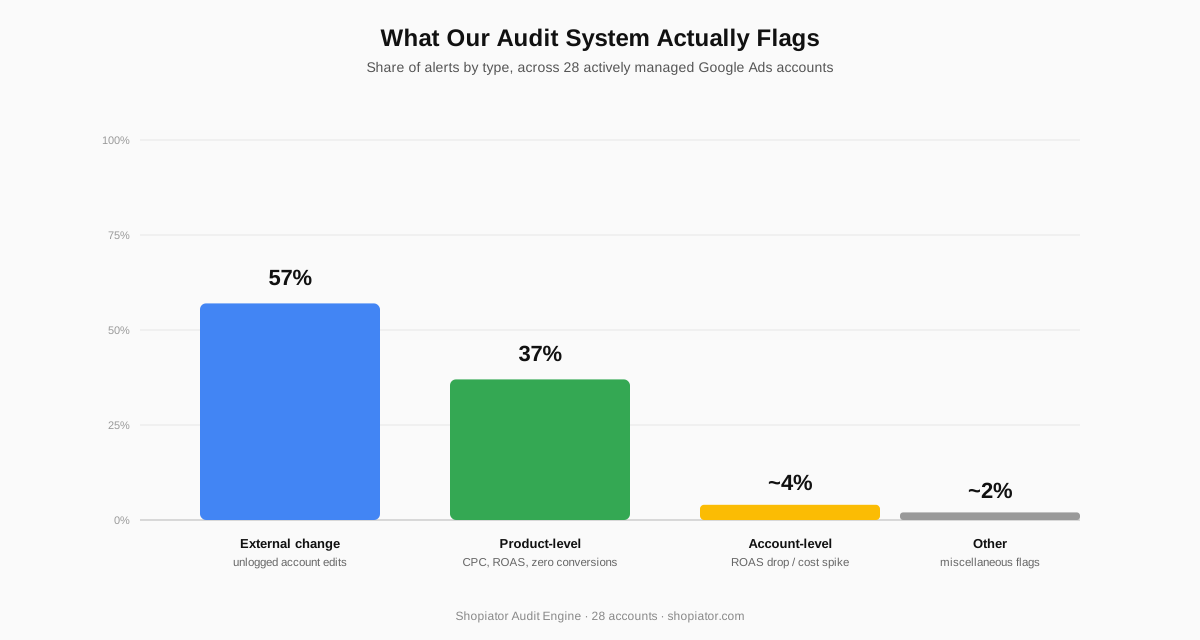
More than half of everything the audit system flags isn't a ROAS drop or a cost spike, it's account hygiene and access control. In practice, that usually means an app, a past freelancer, or a platform auto-apply feature making unlogged changes on a recurring basis. Most advertisers assume the biggest risk to their account is a bad campaign decision. The data says the bigger, more constant risk is simply not knowing who touched the account last.
Product-level leaks far outweigh account-level ROAS problems
Of the same alert pool, product-level issues, high CPC, low ROAS, or zero conversions on individual products, made up 37% of all alerts across 21 of 29 accounts. That's roughly nine times the volume of account-level ROAS-drop and cost-spike alerts combined, which made up about 4% of alerts (shown as "Account-level" in the chart above).
For ecommerce and DTC advertisers running Shopping or PMax, the real leak is usually at the SKU level, not the campaign level. A handful of products quietly burning budget with no conversions is a far more common failure mode than an account-wide ROAS collapse, and it's much easier to miss, because the account-level number can look completely healthy while it's happening. Our full wasted spend audit checklist walks through this and seven other recurring leak patterns in order, including the $50-per-keyword and product-price spend caps we use on every account.
So what
The recurring theme across every finding here isn't creative or targeting, it's bid-strategy hygiene and account governance. Brand and feeder campaigns on the wrong bid strategy, product-level leaks hiding under a healthy account-level ROAS, and unlogged external changes outnumbering every other alert type combined: none of these require a bigger budget or a new campaign type to fix. They require someone actually looking at the account structure, not just the topline ROAS number, on a recurring basis.
If a Google Ads account hasn't had a structural audit, bid strategy per campaign type, SKU-level Shopping/PMax performance, change-log review, in the last 60 to 90 days, there's a good chance at least one of these five issues is quietly present. Shopiator's free audit tool checks for exactly this.
Appendix: two directional findings (3-account sample, not representative)
These two patterns showed up in a smaller slice of the data and shouldn't be read as account-base-wide claims, they're included as directional color, not headline stats.
Spend and conversion value follow a predictable business-hours curve. In a 3-account sample, hourly spend and conversion value both peaked between 9am and 2pm, running roughly 3 to 4x the volume seen between midnight and 4am, while efficiency stayed relatively flat across the day. If that holds at scale, it points to underused dayparting opportunity rather than a demand problem.
Over half of sampled brand search-term spend hadn't converted into exact-match keywords. In the same 3-account sample, 54% of brand-campaign search-term spend came from converting search terms not yet locked in as exact-match keywords. A converting search term on a brand campaign is about as close to a sure bet as PPC gets, worth checking on any account, even though this particular figure isn't broad enough to cite as a study-wide number.
Data Source
This data is aggregated and anonymized from real Google Ads accounts managed by Shopiator. No client names, brand names, account-level figures, or raw click/conversion/spend totals are disclosed, only rates and percentages. We'll refresh this page as new data becomes available.
Want to know if your own account has one of these five issues? Shopiator's free audit tool checks bid strategy, product-level performance, and unlogged changes in minutes.
Get Your Free AuditFrequently Asked Questions
What is the most common issue found in a Google Ads account audit?
Across 28 actively managed accounts, unexplained external changes, edits detected on the account that weren't logged by the agency managing it, made up 57% of every alert logged. That's more than every other alert type combined, and it's rarely a strategy problem. It's usually an app, a past freelancer, or a platform auto-apply feature making unlogged changes on a recurring basis.
What percentage of Google Ads accounts hit their target ROAS?
72% of accounts with an active ROAS target (18 of 25) beat that target on a trailing 30-day basis. The 28% that missed were mostly close, within 10 to 25% of target, which points to a tuning problem rather than a strategy failure.
Should brand search campaigns run on Target ROAS bidding?
No. Brand search should almost always run on Maximize Clicks or Manual CPC to capture volume, not Target ROAS. Running smart bidding on branded terms typically suppresses impression share on the cheapest, highest-intent traffic an advertiser already owns. In the accounts audited, 1 in 8 (12%) still had at least one brand campaign on Target ROAS.
What bid strategy should a feeder campaign use?
Maximize Clicks. A feeder campaign exists to surface new search-term data cheaply, and putting it on a target-based bid strategy (Target CPA, Target ROAS, or Target Impression Share) defeats that purpose and starves the account of the keyword discovery it's supposed to generate. In the accounts audited, 82% of feeder campaigns were misconfigured onto a target-based strategy.
What is a product-level leak in Google Shopping or Performance Max?
A product-level leak is an individual SKU quietly burning budget with a high CPC, low ROAS, or zero conversions, while the account-level ROAS number still looks healthy. In the audit data, product-level alerts (37% of all alerts) outnumbered account-level ROAS-drop and cost-spike alerts (about 4%) by roughly 9 to 1, which is why a healthy topline number can hide a real leak at the SKU level.
How often should a Google Ads account get a structural audit?
Every 60 to 90 days at minimum: bid strategy per campaign type, SKU-level Shopping/PMax performance, and a change-log review. Accounts that go longer without one tend to accumulate exactly the issues in this dataset, unlogged changes, misconfigured feeder and brand campaigns, and quiet product-level leaks.
Does a good account-level ROAS mean the account has no problems?
No. The data shows product-level and hygiene issues are common even in accounts hitting target ROAS overall. A handful of products burning budget with no conversions, or brand and feeder campaigns on the wrong bid strategy, can sit underneath a healthy topline number indefinitely because nobody is checking account structure, only the headline metric.
Ready to fix this on your account?
Talk to the founder directly about scaling your Google Ads.
Keep reading
PMax Architecture for DTC Brands: Feed-Only vs Full-Build
Feed-only PMax and full-build PMax are different products with different risk profiles. Here's how to pick the right one for a DTC ecommerce account.
ReadGoogle AdsIncrementality Testing for Google Ads: How to Actually Measure It
Platform-reported ROAS overstates real impact. Here's how to run a real incrementality test on Google Ads and read the results without fooling yourself.
ReadGoogle AdsSupplement and Healthcare Compliance in Google Ads: The Policy Landmines
Supplement and healthcare advertisers get suspended over specific, predictable policy triggers. Here's what they are and how to advertise without tripping them.
Read