Abandoned Cart Flows for Ecommerce DTC BrandsThe Sequence, the Timing, and How Not to Train Customers to Wait for a Discount
70% of carts are abandoned and 42% of those shoppers were only browsing. Here is the abandoned cart flow built for the rest: two triggers, a three-email core, an escalating store credit branch for first-time buyers only, the margin math on discounts, and a holdout so you know what the flow really earns.
Seven out of ten carts on your store are abandoned. Most guides treat that as a recovery problem and hand you a three-email template. That is half the job.
The other half is knowing which abandoners you can actually recover, keeping the flow from quietly training your customers to wait for a discount, and reading its revenue honestly, because the abandoned cart flow is the single most over-credited automation in every Klaviyo account we open.
This guide covers the whole thing: the two triggers, the benchmarks you are competing against, the core three-email sequence, an escalating store credit variant that keeps incentives off returning customers, the margin math on discounts, and how to measure it without fooling yourself.
Why 70% of Carts Are Abandoned, and Which Ones You Can Recover
Baymard Institute's running meta-analysis of 50 published studies puts the average documented cart abandonment rate at 70.22%, last updated September 2025. That headline number hides the part that matters for flow design: 42% of US shoppers who abandoned a cart said they were just browsing and not ready to buy. No email sequence recovers a person who was never buying.
Strip the browsers out and the remaining reasons are specific, fixable objections. This is the list your flow has to answer, in order of how often each one kills a sale.
| Reason for abandoning at checkout | Share of abandoners |
|---|---|
| Extra costs too high (shipping, tax, fees) | 40% |
| Delivery was too slow | 20% |
| Did not trust the site with card details | 19% |
| Site wanted an account | 18% |
| Checkout too long or complicated | 17% |
| Website errors or crashes | 17% |
| Returns policy unsatisfactory | 13% |
| Could not see total cost upfront | 12% |
| Card declined | 10% |
| Not enough payment methods | 9% |
Baymard Institute, US adults who abandoned a cart in the past quarter, excluding the 42% who were just browsing. Respondents could pick more than one reason.
Read that table as a brief for your email copy. Shipping cost and delivery speed together cover more abandoners than every other reason combined, so a reminder email that never mentions shipping is answering a question nobody asked. Trust in payment and returns policy are the next tier, which is why the second and third emails lean on reviews and guarantees rather than more product photos.
Baymard also estimates that better checkout design alone would recover roughly $260 billion in lost orders across the US and EU, a 35% conversion lift for an average large store. The flow is the safety net. Fixing the checkout is still the bigger lever, and our checkout and funnel solutions guide covers the tooling side of that.
Abandoned Cart vs Abandoned Checkout: Two Triggers, Two Flows
Klaviyo's default flow is labeled Abandoned Cart, but it triggers on the Checkout Started metric, which fires once a shopper enters their email at checkout and moves to the next step. That naming has confused a decade of operators. The trigger is what defines the flow, not the label.
- ▶Abandoned Checkout, trigger Checkout Started. The shopper typed their email and got at least one step into checkout. Highest intent you will see short of a purchase. CTA: Return to Checkout, linking to the live checkout URL.
- ▶Abandoned Cart, trigger Added to Cart. The shopper added something and left before checkout. You only have an email if they are already a known profile. Lower intent, more browsing. CTA: Return to Cart, linking to the cart page.
Run both. The Added to Cart flow needs one filter or it will double-message the people who did start checkout: exclude anyone who has Started Checkout zero times since entering the flow is the wrong direction, so set it as Started Checkout at least once since joining the flow, then exit. Klaviyo's help center documents the exact filter. Start both flows with the same structure and copy, change only the CTA label and the link, then let the data separate them.
For Shopify stores, Checkout Started only fires after the email field is filled, which means your abandoned checkout flow is capped by how early your checkout asks for an email. One-page checkouts and accelerators that collect email first widen the top of this funnel more than any email copy change will.
The Benchmarks You Are Competing Against
Two sets of numbers matter. The first is how automated flows perform against one-off campaigns, from Klaviyo's 2026 benchmark report on 183,000+ brands. The second is the abandoned cart flow specifically.
| Metric | Campaigns | All flows |
|---|---|---|
| Open rate | 31% | 32.2% |
| Click rate | 1.69% | 5.58% |
| Placed order rate | 0.16% | 2.11% |
| Share of email revenue | 59% | 41% from 5.3% of sends |
Klaviyo 2026 email benchmarks, published February 2026. Flows earn 13x the placed order rate of campaigns.
For the abandoned cart flow on its own, Klaviyo's benchmark data has hovered around a 50.5% open rate, a 6.25% click rate, a 3.33% placed order rate, and roughly $3.65 in revenue per recipient, with the top decile of brands reaching about 65% opens and 13% clicks. Omnisend's broader customer base reports lower averages, 35-42% opens and 1.5-2% conversion, which is a useful reminder that the Klaviyo numbers skew toward established DTC brands.
Use these as a floor, not a target. A checkout abandoner is the warmest person in your database. If your flow is under a 3% placed order rate, the problem is usually the sequence or the checkout, not the audience.
The Core Three-Email Sequence Every Store Should Run
The version below is the structure we see work most consistently across the DTC accounts we manage paid media for. It is deliberately plain. The variants further down are where the interesting decisions live.
Email 1: The plain reminder
Send it 1-2 hours after abandonment. One job: put the exact products back in front of them with the exact objections from the Baymard table pre-answered. Dynamic product block at the top, then a short trust row: shipping cost or free shipping threshold, delivery window, returns policy, payment badges. One CTA. No discount, no urgency, no cleverness.
- ▶Subject line angles: the cart is saved, the item is still available, a direct question about whether they had a problem checking out.
- ▶Preview text should open a loop the subject does not close. A short sentence, not a repeat of the subject.
- ▶CTA copy matches the trigger: Return to Checkout for the checkout flow, Return to Cart for the cart flow.
Email 2: Social proof plus urgency
Send it 24 hours after email 1. Product first, reviews second, and the reviews go under the primary CTA, not above it. Pull two or three verbatim customer reviews that address the objections in the table: one about delivery speed, one about the product living up to the page, one about returns or support. Add a real urgency line only if it is true: limited stock, a shipping cutoff, a price change.
Two CTAs pointing at the same checkout link is fine here. One after the product block, one after the reviews. Different entry points, same destination.
Email 3: Handle the objection you have not handled yet
Send it 24 hours after email 2. This is where most templates jump straight to a discount. Do not, at least not for everyone. For returning customers, email 3 is the guarantee email: how the money-back window works, why you can afford to offer it, what happens if they hate it. For first-time buyers, this is where the incentive path starts, and it belongs behind a conditional split.
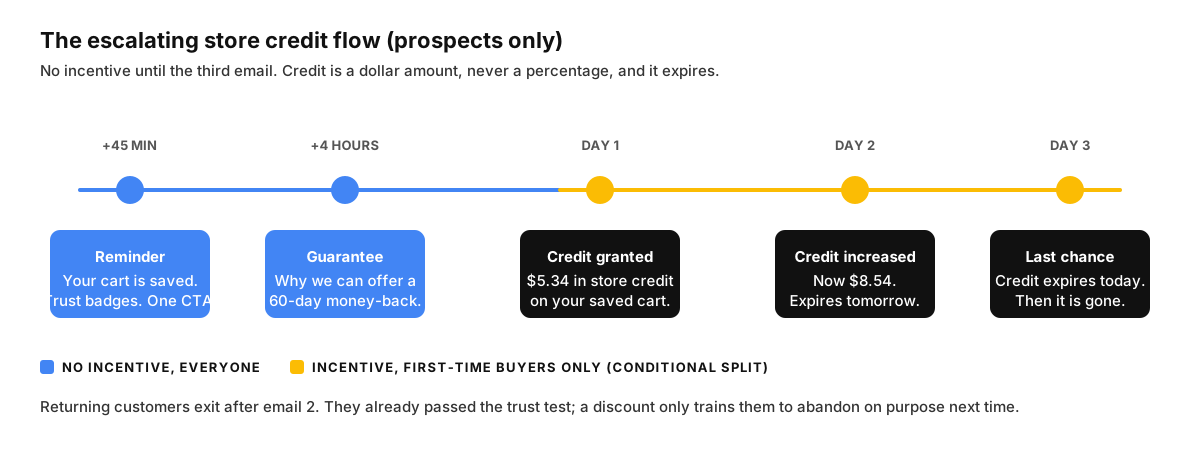
The Escalating Store Credit Flow for First-Time Buyers
A flow structure that has been making the rounds among email operators replaces the percentage discount with a small, specific, expiring store credit that grows over three days. We like it enough to recommend a version of it, with two changes.
| Timing | What it does | |
|---|---|---|
| +45 minutes | Your cart is saved and ready | Plain reminder with trust row. Everyone gets this. |
| +4 hours | Why we can offer a 60-day money-back guarantee | Objection handling. Explains the guarantee mechanics and return rate honestly. Everyone. |
| +1 day | We added $5.34 in store credit to your cart | First incentive. Prospects only. Odd dollar amount, applied automatically. |
| +1 day | Your store credit is now $8.54 | Escalation. Prospects only. States the expiry date. |
| +1 day | Last chance: your credit expires tonight | Deadline. Prospects only. Credit is removed the next morning, and it actually is. |
Timing is measured from the previous email. Swap 60-day for whatever your real guarantee is.
Why a dollar credit instead of 15% off. A specific, odd amount reads like an accounting event rather than a marketing gesture, it never anchors your product to a percentage, and it caps your exposure at a known number per order regardless of cart size. On an $89 cart, $8.54 is 9.6%. Fifteen percent off the same cart is $13.35. The credit costs you less and converts as well or better in the accounts we have watched run both, because the deadline is real and the amount feels earned.
The two changes. First, subject lines must be true. "Your order is ready to ship" when no order exists is a deceptive subject line under CAN-SPAM, and it burns trust with the 42% who were browsing and will remember you. "Your cart is packed and ready" does the same job honestly. Second, the credit has to actually expire. The whole mechanism collapses the first time a customer gets a fourth email with the credit still live.
Discounts: The Conditional Split That Protects Your Margin
The single most important node in the flow is not an email. It is the conditional split after email 2 that separates people who have placed an order before from people who have not. Returning customers already paid you once. They passed the trust test. Sending them a discount does not recover a sale, it teaches them that abandoning a cart is how you get 15% off, and they will do it on every order from then on.
First-time buyers are different. The first order is the hardest thing you will ever ask of them, and it is where the lifetime value math says to spend. If you use a percentage, 10-20% is the ceiling and you should start at the bottom of that range. Better, use the store credit structure above.
Before you pick a number, run the margin math. A product selling at $89 with a 40% contribution margin makes $35.60 before acquisition cost. A 15% discount hands back $13.35 of that, 37.5% of the profit on the order. An $8.54 credit gives back 24%. Layer in the payment fees, returns, and fulfillment that most founders forget, and the gap widens further. Our hidden costs breakdown and profit calculator shows why most stores have less room for a discount than they think.
- ▶Never discount by default. Run the split with no incentive first for two weeks, then add the incentive branch and compare placed order rate and margin per recipient, not just revenue.
- ▶Free shipping or a free gift often beats a percentage at the same cost, because it answers the number one abandonment reason directly.
- ▶Cap the incentive branch to one flow. A prospect who also sees a 15% welcome pop-up and a 10% exit-intent offer is being trained faster than you think.
Timing, Sender Name, and Preview Text: What to Test First
Everything in the flow is testable, and the traffic on a checkout abandonment flow is usually high enough to reach a real answer in weeks rather than months. Start with the variables that move open rate, because nothing downstream can beat a closed email.
| Variable | Starting point | What to test against it |
|---|---|---|
| Delay before email 1 | 1-2 hours | 30-45 minutes for checkout starters, 4 hours for cart adders |
| Gap to email 2 | 24 hours | 12 hours for consumables, 48 hours for considered purchases |
| Sender name | First name from Brand | Brand only, and founder full name |
| Preview text | One-sentence open loop | A repeat of the subject, to prove the loop is doing work |
| Incentive | None | Store credit, then free shipping, then percentage |
Test one variable at a time and read open rate for sender and subject tests, click and placed order rate for everything else.
On sender name, personalization usually wins on opens, but it depends on how the brand has introduced itself elsewhere. A founder-led brand that shows a face on the homepage can send from the founder. A brand that has never named a person should not start in the abandoned cart flow. The A/B testing tools guide has the traffic floors for reading any of these tests honestly.
SMS: The Second Channel, Used Sparingly
For checkout starters who gave you SMS consent, one text 30-60 minutes after abandonment, before email 1, recovers a meaningful share of the people who left over a payment glitch or a distraction. Keep it to the cart link and one line. A second text with the store credit on day 2 is the most you should send. More than that and the unsubscribe rate on the channel that costs you the most per message climbs fast. SMS consent rules in the US are strict and enforced, so the flow only enters people who explicitly opted in to marketing texts.
The Reporting Trap: Your Flow Is Not Making What Klaviyo Says
Every email platform credits the abandoned cart flow with revenue from anyone who bought after opening or clicking within the attribution window. The flow's audience is people who were already at checkout with a card in hand. A large share of them were going to complete the purchase anyway, email or no email. The default report counts all of them.
We wrote a full breakdown of how Klaviyo inflates email attribution and how to fix the settings. For this flow specifically, the fix is a holdout. Add a random sample split at the top of the flow, route 10% to a branch with no emails, and compare placed order rate between the two branches over 30 days. The difference is the flow's real contribution. In most accounts it is well under half of the number on the dashboard, and still comfortably worth running.
Turn off opened-email attribution while you are in there. On a flow where half the audience opens, Apple Mail's automatic pre-fetch alone can credit the flow with sales nobody read an email for.
Email Capture Comes First
None of this fires without an email address. The Checkout Started trigger needs the email field completed, and the Added to Cart flow only reaches known profiles. If your capture rate on new visitors is low, the abandoned cart flow is a beautifully built machine with nothing going into it.
That means the pop-up strategy, the timing of the email field in checkout, and whether Shop Pay or an accelerator recognizes returning shoppers are all upstream of this flow. Fix capture first, then build the flow, then optimize the flow. Most stores do it in the opposite order.
The Abandoned Cart Flow Checklist
- 1.Build two flows: Checkout Started and Added to Cart, with the dedupe filter on the cart flow.
- 2.Email 1 within 1-2 hours: dynamic products, trust row that answers shipping, delivery, returns, and payment security. One CTA, no discount.
- 3.Email 2 at 24 hours: product first, two or three verbatim reviews under the CTA, urgency only if it is true.
- 4.Conditional split: has placed an order before. Returning customers get the guarantee email and exit. Prospects enter the incentive branch.
- 5.Incentive branch: store credit in a specific dollar amount, escalating once, expiring for real. Percentage discounts capped at 10-20% if you must.
- 6.One SMS at 30-60 minutes for opted-in checkout starters. Two maximum in the whole flow.
- 7.Random 10% holdout at the top of the flow. Read placed order rate against it after 30 days.
- 8.Disable opened-email attribution in Klaviyo settings.
- 9.Test sender name and subject on open rate first, then delays, then incentive type. One variable at a time.
- 10.Fix email capture and checkout friction before spending another hour on email copy.
Where paid media fits
The abandoned cart flow only reaches people who gave you an email. Google Ads remarketing and a dedicated remarketing Performance Max campaign catch the rest of the 58% with real purchase intent, including the 42% of checkout starters who never typed an address. If the flow is built and the checkout is fixed, that remarketing layer is the next lever, and it is what we build for the brands we manage.
Frequently Asked Questions
What is the average cart abandonment rate for ecommerce?
Baymard Institute's meta-analysis of 50 studies puts the average documented online cart abandonment rate at 70.22%, last updated in September 2025. About 42% of those abandoners say they were just browsing, so roughly 58% of abandoned carts had real purchase intent worth recovering.
What is the difference between an abandoned cart flow and an abandoned checkout flow in Klaviyo?
The trigger. An abandoned checkout flow fires on the Checkout Started metric, when a shopper has entered their email and moved a step into checkout. An abandoned cart flow fires on Added to Cart, when a known profile adds an item but never starts checkout. Klaviyo's default flow is labeled Abandoned Cart but actually uses the Checkout Started trigger. Run both, with a filter on the cart flow that exits anyone who starts checkout.
How many emails should an abandoned cart flow have?
Three is the minimum that consistently outperforms one: a reminder within 1-2 hours, a social proof and urgency email at 24 hours, and an objection or incentive email at 48 hours. Flows with an incentive branch for first-time buyers typically run five emails over about three days, with the incentive escalating once and then expiring.
What are good benchmarks for an abandoned cart email flow?
Klaviyo's abandoned cart benchmark data sits around a 50% open rate, a 6% click rate, a 3.3% placed order rate, and roughly $3.65 revenue per recipient, with top-decile brands reaching about 65% opens and 13% clicks. Omnisend's broader base reports 35-42% opens and 1.5-2% conversion. Klaviyo's 2026 report shows flows in general earning a 2.11% placed order rate against 0.16% for campaigns.
Should I offer a discount in my abandoned cart emails?
Not by default, and never to returning customers, who learn to abandon carts on purpose to trigger it. For first-time buyers, test a no-incentive version first, then add an incentive branch behind a conditional split. A specific dollar amount of expiring store credit usually costs less than a percentage discount and does not anchor your brand to a sale price. If you use a percentage, 10-20% is the ceiling.
When should the first abandoned cart email be sent?
Within 1-2 hours for most stores. Checkout starters respond well to 30-45 minutes because many left over a glitch or a distraction and are still nearby. Cart adders who never started checkout can wait 2-4 hours. Test the delay against open and placed order rate, not against what a template says.
How do I know if my abandoned cart flow is actually making money?
Add a random 10% holdout branch at the top of the flow that receives no emails, then compare placed order rate between the two branches over 30 days. The difference is the flow's real incremental contribution. Default attribution credits the flow with every purchase after an open or click, and most of these shoppers were already at checkout, so the dashboard number is usually far higher than the true lift.
Ready to fix this on your account?
Talk to the founder directly about scaling your Google Ads.
Keep reading
Why You Can't Hire a Great Full-Time In-House Media Buyer (The Math Nobody Shows You)
"Full-time in-house Meta Media Buyer, no other projects" sounds like a job requirement. It's actually a pay cut that filters out every good Media Buyer. Here's the math.
ReadStrategyThird-Party Attribution Tools: Good, Bad, and Ugly
Third-party attribution tools fix a real double-counting problem, but they also lock in your conversion history and get sold with a benefit-to-cost ratio that rarely holds up. A straight breakdown of when they're worth it and when they aren't.
ReadGoogle AdsGoogle Ads Benchmarks for Ecommerce Brands (2026): Real CPC, CTR, ROAS, CPA & CPM Data
Real Google Ads performance benchmarks from 25 ecommerce accounts across the US, UK, Canada, and Australia, covering January 2025 through Q3 2026: average CPC, CTR, conversion rate, ROAS, CPA, and CPM, broken down by Performance Max, Shopping, Search, Demand Gen, Display, and YouTube, by country and by quarter. First-party data, not a scraped roundup.
Read