
A viral thread is circulating in the DTC Google Ads world. The claim is dramatic: an agency tested switching the domain on 40+ ecommerce accounts (same products, same ads, same campaigns) and CPCs dropped by up to 75% in 1-5 days. The framing is even more dramatic: Google has been overcharging advertisers all along, the domain switch is the proof, and there is a class action waiting to happen.
The CPC drop is real. The framing is wrong. The mechanism the author is describing does not match how Google's auction actually works. The mechanism that does fit the data also predicts that the CPC drop reverses within 4-6 weeks, which is probably why the screenshots end where they do.
This post breaks down what actually happens when you swap a domain, why the screenshots in viral threads are designed to hide the reversal, what risks the author buries, and a 6-point smell test you can use the next time a Google Ads thread goes viral with a hack that sounds too good to be true.
The Viral Claim
The thread runs the following argument. The author and his agency changed the domain on 40+ Google Ads accounts, kept everything else identical (same ads, same products, same account, same campaigns), and CPCs dropped by as much as 75% within a week. He concludes that Google has been quietly overcharging advertisers by what he estimates to be billions, that the original CPC was never about the click, and that there is a class action's worth of evidence sitting in any account that wants to test it.
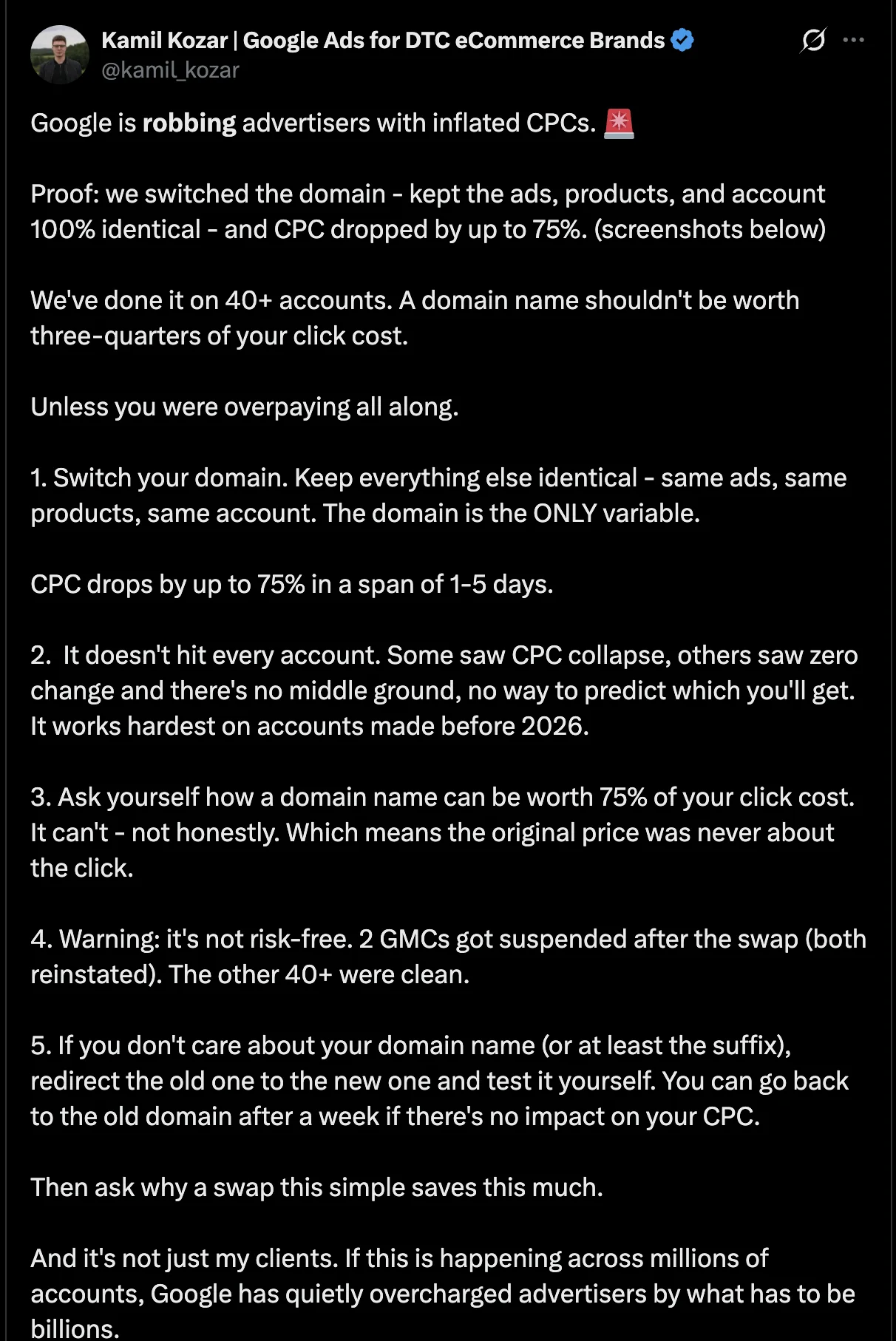
He shared four account dashboards as proof. Three were Google Ads accounts in EUR and USD; one was redacted. All four had a labeled "Domain Switch" vertical line, after which the CPC plot drops sharply. On three of the four, the conversion line then spikes upward in the weeks following.
That is the version that ships. Now let's read what those same screenshots show that the headline does not.
What's Actually Happening: Smart Bidding's Confidence Reset
Google's smart bidding does not sell traffic. It sells predicted conversions and predicted conversion value. The bid it submits in any given auction is a function of how confident the algorithm is that this specific click will turn into a conversion at a specific value. High confidence means higher bids. Low confidence means lower bids.
That confidence is built from historical data: clicks, conversion actions, landing page behavior, audience signals, time of day, device, query, and yes, the destination URL pattern. When the destination domain changes, the historical data attached to the old domain becomes partially or fully unusable for predicting behavior on the new one. The model has to rebuild its prior.
The exploration phase in one paragraph
When smart bidding loses its prior, it goes into exploration mode. It bids conservatively because over-bidding without confidence is an expensive way to learn. Conservative bids produce lower CPCs. Lower CPCs produce lower impression rank on the same auctions, which means fewer impressions on the head queries and more impressions on the long tail (which is where the cheaper clicks live). The CPC chart falls. The conversion chart stays low for a beat, then climbs as the model gathers enough new data points to start bidding with confidence again. Usually 4-6 weeks for accounts with healthy conversion volume. Longer for thin accounts.
This mechanism explains every shape in the viral screenshots: the immediate CPC drop, the brief conversion dip, the spike in conversion volume as Google reaches deeper into the long tail at discount prices, and the slow climb of CPC back toward the prior equilibrium that the screenshots end before showing.
It also explains the inconvenient line the author included in his own thread: "some saw CPC collapse, others saw zero change, no way to predict." Accounts with thin conversion data have no confidence prior to reset, so there is no exploration phase to trigger. Accounts with deep conversion data have a strong prior, so the reset is dramatic. That variance is exactly what the confidence-reset model predicts. It is not what an "all accounts overcharged equally" model would predict.
The crucial point: the CPC drop is genuine, but it is the bid the algorithm chose to submit, not the price the auction was charging. The auction price hasn't changed. The algorithm's willingness to bid into it has, temporarily.
Reading the Screenshots Properly
The thread presents four accounts as proof. Below is what each of those four screenshots actually shows when you read past the red "Domain Switch" arrow:
Account 1
EURSwitch: Week of Feb 23, 2026- Full-period CPC
- €0.46 (up €0.06)
- Full-period conversions
- 6,011 (up 193)
What he's showing
Conversion line spikes after the switch; CPC line drops from €1.09 to ~€0.40.
What he's not showing
Total conversion uplift across 9 months is +193, not a transformation. No ROAS, no revenue, no AOV.
Account 2
RedactedSwitch: Week of Feb 16, 2026- Full-period CPC
- Hidden
- Full-period conversions
- Hidden
What he's showing
CPC dropped to ~€0.35 after the swap. Conversion line recovers post-switch.
What he's not showing
GMC was suspended in the same window and then reinstated. Two major variables changed, not one. The recovery is partly the GMC reinstatement.
Account 3
EURSwitch: Week of Apr 6, 2026- Full-period CPC
- €1.05 (up €0.18)
- Full-period conversions
- 2,438 (down 2,791)
What he's showing
CPC line drops from €2.31 to ~€0.50 in the week of the switch.
What he's not showing
Total conversions for the period are NEGATIVE by 2,791 vs the prior comparable window. The 'win' is a CPC line, not a business outcome.
Account 4
USDSwitch: Week of Apr 6, 2026- Full-period CPC
- $0.74 (up $0.16)
- Full-period conversions
- 13,881 (down 32,449)
What he's showing
CPC drops from $1.62 to ~$0.30 after the switch. Conversion line recovers a few weeks later.
What he's not showing
Total conversions across the full period are DOWN by 32,449. That is not a typo. Thirty-two thousand fewer conversions, sold as a victory.
The combined picture: two accounts show net-negative conversion totals across the full period. One account is confounded by a GMC suspension and reinstatement happening in the same window. Only one account shows a clean modest uplift in total conversions, and we don't see revenue or ROAS on any of them. This is not proof of a CPC overcharge. It is a curated set of CPC charts with the inconvenient metrics omitted.
When asked directly in replies for 90-day ROAS, revenue, or cost per conversion comparisons, the author's response was "you can literally see the spike of sales on each screenshot." Conversion count is not revenue. The spike of points on a line chart is not a P&L. Refusing to publish the 30/60/90-day backend is the loudest signal in the thread.
The Risks the Thread Buries
The viral version of the post lists the risks as a parenthetical in bullet 4: "2 GMCs got suspended after the swap (both reinstated). The other 40+ were clean." Read that sentence like an operator instead of a marketer.
A 5% GMC suspension rate is catastrophic, not a footnote
Two suspensions out of 40 is 5%. For any account whose Shopping and Performance Max revenue is non-trivial, a one-in-twenty chance of a multi-day-to-multi-week revenue blackout is not a risk you take for a 5-day CPC chart. Reinstatement is not free either - it takes operator time, often takes 3-10 days, and on misrepresentation suspensions the second strike is permanent on that domain.
Quality Score history resets
Quality Score is built on expected CTR, ad relevance, and landing page experience signals tied to the destination URL. A new domain means new baselines. For accounts where Quality Score was actively suppressing CPC (a 7-10 QS pays significantly less per click than a 3-5 QS for the same auction), the reset can quietly raise your real auction cost even as the smart-bidding-driven CPC chart falls in the short term.
Every campaign goes back into learning
Significant changes (and a destination domain change is significant) put smart bidding campaigns into a learning state. Learning means more variance, less efficient pacing, and a temporary blunting of the algorithm's ability to capture your highest-value clicks. For 2-4 weeks per campaign, you are paying for the algorithm's training data instead of profit.
SEO and direct-traffic equity is partially lost
Even with clean 301 redirects, a domain change drops a non-trivial percentage of organic search traffic, branded direct traffic, and link equity. If your paid acquisition was the smallest part of the funnel and organic/branded/email were the volume drivers, you are trading a CPC chart improvement for a topline revenue hit that the Google Ads dashboard will never show you.
Tracking, payment processors, and tag setups all need re-validation
Conversion tracking, GA4 streams, Meta CAPI, Klaviyo events, payment gateway whitelists, and any third-party app that authenticated against the old domain need to be re-tested. Operators routinely lose 2-5 days of clean conversion data while these are re-validated, which itself starts to look like a 'CPC win' until you reconcile the numbers.
The 6-Point Claimbait Smell Test
Save this section. The next viral Google Ads "hack" will follow the same pattern, and you can run any of them through this checklist in 60 seconds.
Check the metric vs the outcome
CPC is not ROAS. Conversion count is not revenue.
Read the full test
Every viral Google Ads thread leads with a metric that moves dramatically and buries the metric that pays the bills. CPC, CTR, CPM, and impression share are inputs. Revenue, gross profit, and contribution margin are outputs. They are not the same axis and they often move in opposite directions.
When someone shows you a CPC chart with no ROAS, assume the ROAS is bad. When someone shows you conversion count with no revenue, assume AOV collapsed. When someone shows you 'sales spiked', ask for the dollar figure, not the count.
Applied to this caseThe domain-switch thread shows CPC dropping 75%. It never shows ROAS, revenue, AOV, or cost per conversion. Three of the four screenshots show negative conversion totals across the full period.
Count the variables that changed
A real test changes one thing. Viral threads change three and credit one.
Read the full test
Smart bidding is sensitive to a long list of inputs. A domain change is almost never the only thing that moves with it. Quality Score baselines, page experience signals, landing page speed, GMC standing, structured data, and even the SSL certificate handshake all live downstream of the domain.
The honest framing is 'we changed many things at once and saw a CPC drop'. The dishonest framing is 'we kept everything 100% identical and only the domain changed'. The second is what viral threads claim. It is rarely true.
Applied to this caseOne of the four accounts in the viral thread had a GMC suspension and reinstatement in the same window as the domain switch. That is two channel-level disruptions, not one.
Check the sample size and the distribution
'We tested 40 accounts' means nothing without the distribution.
Read the full test
A real claim about 40 accounts shows you the spread. How many saw a CPC drop, how many saw no change, how many saw a degradation. A claim that gives you 4 screenshots and tells you to trust the rest is showing you a curated tail.
The author of the viral thread acknowledged in his own copy that 'some saw CPC collapse, others saw zero change, no way to predict'. That sentence alone disproves the universal mechanism he is selling.
Applied to this caseFour screenshots out of '40+ accounts' is a 10% disclosure rate and you do not get to see whether the other 90% support or undermine the thesis.
Look at the window length, not just the direction
5 days of post-change data is the exploration phase, not the equilibrium.
Read the full test
Smart bidding takes 4 to 6 weeks to stabilize after any significant input change. New conversion action, new bid strategy, new audience signal, new feed, new domain - all of them trigger an exploration phase where Google bids conservatively while it rebuilds its conversion probability model.
Conservative bidding produces lower CPCs. That is the dip. Then the model rebuilds and CPCs return to the new equilibrium, which is usually very close to the old one if the underlying landing page experience is the same. The 5-day snapshot is measuring the dip, not the destination.
Applied to this caseThree of the four screenshots show 5-6 weeks of post-switch data on a 9-month axis. The relearning curve is not done yet. The viral claim is measuring a phase, not an outcome.
Pressure-test the mechanism in one sentence
If you cannot say WHY in one sentence, the thesis is broken.
Read the full test
Ask any viral Google Ads claim to explain the mechanism without metaphors. 'Google is robbing you' is not a mechanism, it is a vibe. 'Smart bidding resets its conversion probability prior when the domain changes' is a mechanism, and it predicts the exact behavior the screenshots show, AND it predicts the reversal that the screenshots do not run long enough to capture.
The right mechanism explains the dip AND the recovery. If the proposed mechanism only explains the dip, it is incomplete.
Applied to this caseThe 'Google overcharges advertisers' frame cannot explain why some accounts see no change at all from the same domain swap. The 'smart bidding confidence reset' frame predicts exactly that variance based on how mature the conversion data on each account is.
Ask for the 90-day follow-up
Anyone making a Google Ads performance claim owes you 90 days.
Read the full test
Smart bidding cycles, seasonality, return rates, repeat purchase windows, and customer cohorts all need at least 60-90 days to read accurately. A 5-day snapshot of CPC is the equivalent of a Black Friday traffic chart presented as your annual run rate.
If the operator cannot or will not show 90-day cost per acquisition, 90-day ROAS, and 90-day net revenue against the pre-change baseline, the post is a teaser. The follow-up does not exist because the follow-up does not support the claim.
Applied to this caseThe viral thread shipped on the strength of a 5-day CPC drop. There has been no 90-day follow-up, no ROAS disclosure, no cost-per-conversion comparison, and the responses to direct asks have been 'you can literally see the spike in sales'. Sales count is not sales.
What Actually Lowers Your CPC
If your CPCs are climbing on a real account, there are well-understood levers to pull. None of them require a domain swap and none carry the 5% catastrophic-event risk.
Fix landing page conversion rate first
Smart bidding bids up when expected conversion probability is high and bids down when it is low. The fastest way to drop your CPC honestly is to ship a landing page that converts better. Higher conversion rate means Google can hit your tROAS with fewer clicks and less aggressive bidding.
Cap the bid strategy
Maximize Conversion Value with no tROAS cap is a license for Google to bid whatever it wants. Set a tROAS that matches your real break-even (after returns, COGS, processing, and shipping) and CPCs will fall into line. If the algo cannot hit the tROAS, it will pull back impressions before it overpays.
Clean search term hygiene
On feeder search and Performance Max, half of the CPC inflation is irrelevant queries the algo is paying to test. Pull the search terms report weekly, add negatives ruthlessly, and CPCs on the queries that actually convert will drop because the campaign stops competing with itself for bad traffic.
Exclude brand from non-brand campaigns
If brand terms are slipping into your non-brand search or PMax, the campaign's blended CPC looks fine because brand is cheap, but your incremental non-brand CPC is silently rising. Add brand as a negative on every non-brand campaign and you will see the real number.
Audit Quality Score inputs
Expected CTR, ad relevance, and landing page experience are the three Quality Score components. All three are fixable: tighter ad groups, ad copy that matches the search intent, faster pages, better message-match. None of them require a domain change.
Check auction competition
If your CPC is climbing, it is often because a competitor entered the auction or doubled their budget. Auction Insights tells you which competitors are now showing against you and where. A domain switch does not fix auction pressure. A change in bid strategy or audience signal sometimes does.
Frequently Asked Questions
If I switch my domain, will CPCs really drop in the short term?
Why do some accounts see no change at all from a domain swap?
Doesn't a CPC drop prove Google was overcharging?
What is the real risk of swapping the domain just to test?
If switching the domain works for 5 days, why not just keep switching?
Is this advice different for accounts running Manual CPC vs Smart Bidding?
What if my CPCs really are too high - what should I actually do?
Does this mean Google Ads is fairly priced and no one should question it?
A 5-day CPC drop is a measurement, not a strategy. A 90-day ROAS is a strategy.
Want to know whether your CPCs are actually inflated?
The operator audit runs a full manual review of your live Google Ads account: bid-strategy hygiene, Quality Score inputs, search term waste, brand-vs-non-brand cannibalization, and the silent CPC killers that no viral thread will tell you about.
Keep reading
Why Most Ecom Brands Fail at Google Ads
Most ecommerce brands waste 15-30% of their Google Ads budget without knowing it. Here are the 7 most common mistakes and how to fix each one.
ReadGoogle AdsHow to Choose the Right Google Ads Agency for Ecom
Not all Google Ads agencies are built for ecommerce. Here are the 8 questions to ask before hiring one - and the red flags that signal you'll waste your money.
ReadGuideHow Not To Hire A Google Ads Agency (2026)
Bargaining your retainer down, demanding guarantees, and offering lifetime deals signal a worse founder, not a smarter one. What to evaluate instead of price.
Read